DIAMONDS
17 October 2026
Oval Engagement Ring Guide: Ratio, Settings, Size in mm
Twenty oval engagement ring centres in mm, with length to width ratios, the bow-tie explained and twelve settings, set against a UAE size 52 finger.
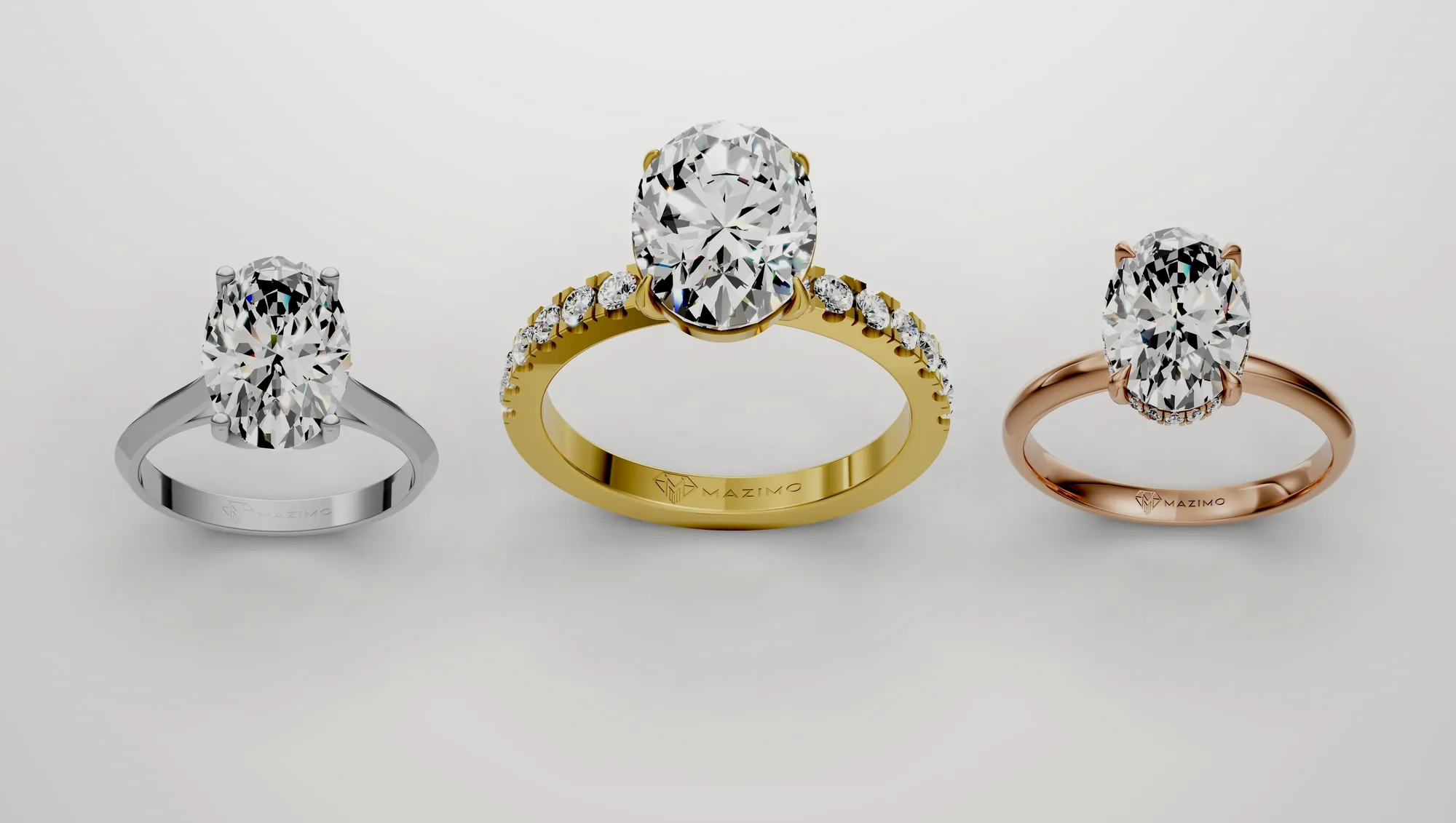
An oval engagement ring has a long, rounded centre stone, and it is first described by its length divided by its width. GIA's oval cut guide (23 September 2025) calls 1.40 to 1.50 the most popular range. Mazimo, a Dubai jeweller, makes 20 oval rings, and their centres have length to width ratios of about 1.38 to 1.55. Our Oval Pavé Solitaire Ring, 2 ct is about 10.02 × 7.11 mm, and 10.02 ÷ 7.11 is about 1.41.
At a glance
- Twenty of Mazimo's 48 diamond rings have an oval centre (as of October 2026), and our arithmetic from each listed centre size gives length to width ratios of about 1.38 to 1.55.
- Those centres are about 5.60 to 11.82 mm wide, or about 34 to 71 percent of a UAE size 52 finger.
- Carat measures weight, not size, so this guide compares millimetres.
- Sixteen of the 20 have a camera try-on. For the other four, ask which we can show at Al Manal Center.
- Our designer draws a 1 ct oval at a length to width ratio of about 1.35: a preview, not a finished ring.
What makes an oval engagement ring different from a round?
An oval is longer than it is wide, and its outline is a smooth curve with no corners. GIA says that elongated shape gives a larger surface area than a round diamond of the same carat weight, and that rounded edges make an oval less prone to chipping than a princess or a marquise.
Less prone is not immune: GIA warns that an extremely thin girdle may raise the risk of chipping. Check the outline too. GIA looks for smooth curves with no flat spots, since flat shoulders can make an oval look like a rounded marquise and bulging ones too pill shaped.
Oval diamond size chart in mm: 20 Mazimo rings measured
Carat is weight, not size. GIA says so, and IGI says diamonds of the same carat weight do not necessarily appear to be the same size. So Mazimo's 20 oval rings are listed in millimetres, shortest to longest, from about 7.93 × 5.64 mm to about 18.38 × 11.82 mm.
Ratio is length ÷ width. Share of finger is width ÷ about 16.55 mm, the inside diameter of a UAE size 52: sizes are inner circumference in millimetres, and 52 ÷ 3.14159 is about 16.55. So the Oval Pavé Solitaire Ring, 2 ct, at 7.11 mm wide takes 7.11 ÷ 16.55: about 43 percent.
All sizes are approximate and as of October 2026, to two decimals from each ring's specification; the Bypass ring's is given to one. Ratios and shares are our arithmetic. Ring pages print one decimal, so dividing those figures can move a ratio by about 0.01: the Oval and Pear Five Stone Ring then gives 1.51.
Our site rounds the carat on a ring card up, and stones differ in weight and proportion. So the six rings whose card or name reads 1.5 ct run from about 8.24 to 9.60 mm long: compare the millimetres.
On a UAE size 52 finger, the centres take up about 34 to 71 percent of the finger's width. Our guide to engagement rings for small hands covers the method and other sizes, and our camera try-on guide explains why the camera does not measure your finger.
What is the ideal length to width ratio for an oval?
GIA gives no single ideal ratio, only bands described by look, so none is a pass mark. A ratio near 1.35 gives a gently elongated oval, and near 1.45 a longer, more traditional one.
| Ratio (L ÷ W) | GIA describes it as | At Mazimo |
|---|---|---|
| 1.20 to 1.29 | Shorter and rounder, may resemble a rounded cushion | None of our 20 rings |
| 1.30 to 1.40 | Rounder, gently elongated | Designer 1 ct oval, about 1.35; Oval Halo Solitaire Ring, about 1.38 |
| 1.40 to 1.50 | Traditional, the most popular range | 18 of our 20 finished rings |
| Above 1.50 | Rarely seen, may show a more pronounced bow-tie | One of our 20 rings: Oval Side Stone Ring, 10 ct, about 1.55 |
Our designer draws a 1 ct oval at about 7.7 × 5.7 mm, and 7.7 ÷ 5.7 is about 1.35. Our 20 finished rings run from about 1.38 to 1.55, so real stones are longer and slimmer than the designer table. That is not an error: the designer scales one set of proportions by weight.
At the 7.11 mm width of the Oval Pavé Solitaire Ring, 2 ct, a 1.35 oval would be about 9.60 mm long (7.11 mm times 1.35); its stone is about 10.02 mm. For the designer's sizes across every shape, see our diamond size chart in mm.
Oval vs round engagement ring: which looks bigger?
At the same carat weight, GIA says an oval's elongated shape gives more surface area than a round. In our range, take two rings that both read 2 ct: the Oval Pavé Solitaire Ring, 2 ct is about 10.02 × 7.11 mm, and the Round Six Claw Solitaire Ring is about 8.00 × 8.03 mm.
We treat each outline as an ellipse, so area is π ÷ 4 × length × width. That gives about 55.95 mm² for the oval and about 50.45 mm² for the round: about 11 percent more. The Round Pavé Solitaire Ring, about 7.95 × 8.01 mm, gives about 12 percent. It is our arithmetic from listed rings, not a measured area or a rule, and the stones need not weigh the same.
The oval gives up one thing. GIA gives its overall cut grade only to the round brilliant, so a GIA report for an oval carries polish and symmetry but no overall cut grade. Other laboratories grade cut their own way, and we state no laboratory for any ring. Our guide to Excellent and Ideal cut grades explains the grades.
The bow-tie: what it is and how to judge it
The bow-tie is a darker band across the middle of an oval, and GIA says some degree of it is always present. What matters is how strong it looks in your stone.
GIA explains it as light blocked by the viewer's own head and shoulders, so it looks stronger the closer your face is. A well cut oval keeps it small, and a subtle one can add character. Ovals above 1.50 may show more, yet GIA's own example of a noticeable bow-tie is a 1.48 oval: a ratio inside the popular band is no guarantee.
GIA advises viewing the stone in person or requesting videos, because bow-tie visibility varies within one ratio range. Our ring pages hold no bow-tie, cut or symmetry assessment for any centre diamond, so we cannot say which of the 20 shows more or has the most even outline. Before you order, ask us on WhatsApp what can be shown. Our guides to marquise versus oval and oval versus pear say more.
Oval engagement ring settings: the twelve we make
We make twelve settings around an oval, from a plain four-claw solitaire to a five stone ring.
- Plain four-claw solitaire. The Oval Solitaire Ring, 3.5 ct has a four-claw centre on a plain band. GIA calls prong settings a classic choice for ovals.
- Pavé band. The Oval Pavé Solitaire Rings set the centre in four claws over small diamonds on the band: 16 rounds of about 1.8 mm at 1.5 ct, 14 at 2 ct. Pavé can limit resizing, so give us your size before we finish the ring.
- Tulip claws. The Oval Tulip Pavé Solitaire Ring sets the centre in tulip-shaped claws, with 14 rounds of about 1 mm beneath it on a plain band.
- Oval engagement ring with a hidden halo. The Oval Hidden Halo Solitaire Ring holds 22 rounds of about 0.9 mm beneath the centre. The Oval Hidden Halo Shoulders Ring adds 12 shoulder rounds, and the Oval Pavé Hidden Halo Ring, 5.5 ct adds a pavé band.
- Halo, with a pavé or a plain band. The Oval Halo Pavé Ring has 22 halo rounds of about 1 mm and 18 band rounds of about 1.4 mm; the Oval Bold Halo Pavé Ring has 20 and 16. The Oval Halo Solitaire Ring has 26 halo rounds of about 1.2 mm on a plain band. GIA says a halo can make the diamond appear larger. Our halo ring guide covers upkeep.
- Bezel. The Oval Bezel Solitaire Ring sets the centre in a bezel, with 25 rounds of about 1 mm beneath it. GIA says a bezel protects well and suits active lifestyles; our bezel versus prong guide compares the two.
- Cluster. The Oval Cluster Ring has three rounds of about 2 mm on each side of the centre.
- Marquise shoulders. The Oval Marquise Shoulders Ring sets eight marquise diamonds of about 3.6 × 1.8 mm on the shoulders.
- Bypass. The Oval Marquise Bypass Ring sets marquise diamonds along the sweep of the band.
- Oval shoulders. The Oval Side Stone Ring, 10 ct sets ten oval diamonds of about 5.0 × 3.0 mm along both shoulders of the band.
- Oval engagement ring with side stones: three stone. The Oval and Pear Three Stone Ring flanks the oval with two pears of about 6.8 × 4.4 mm. The Oval and Pear Three Stone Pavé Ring sets two pears of about 4.4 × 3.0 mm and adds 14 band rounds of about 1.6 mm. The Oval and Marquise Three Stone Ring flanks the oval with two marquises of about 5.0 × 2.5 mm. GIA says ovals pair well with side stones.
- Oval engagement ring with side stones: five stone. The Oval and Pear Five Stone Ring adds pears down the shoulders: two of about 6 × 4 mm and two of about 4.5 × 3 mm.
Camera try-on exists on 16 of the 20 ovals. The four without it are the Oval Hidden Halo Shoulders, Oval Bezel Solitaire, Oval Marquise Bypass and Oval and Pear Five Stone rings: ask which we can show. Our designer draws only five settings; our settings guide compares them.
Oval engagement ring in white, yellow or rose gold
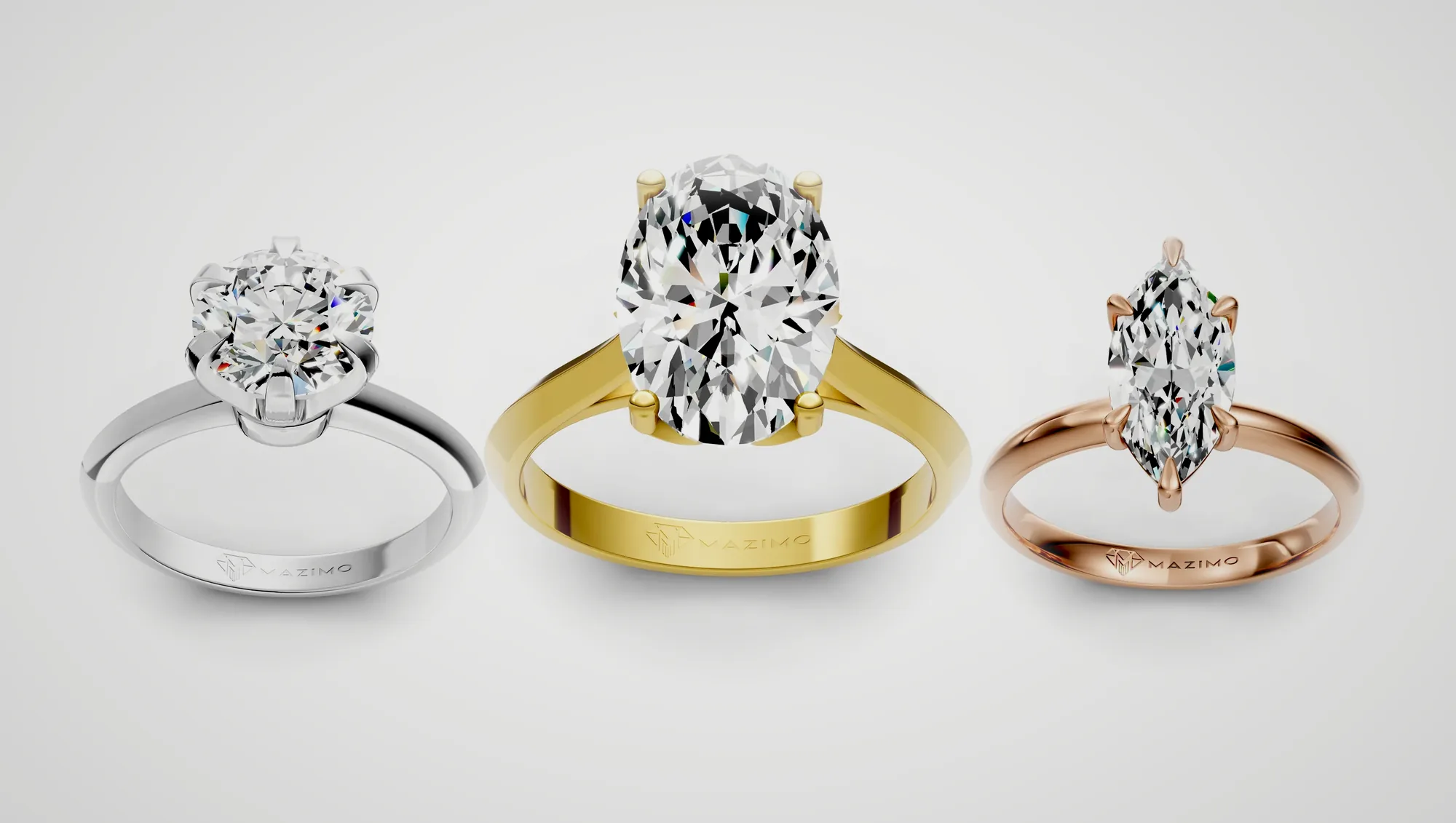
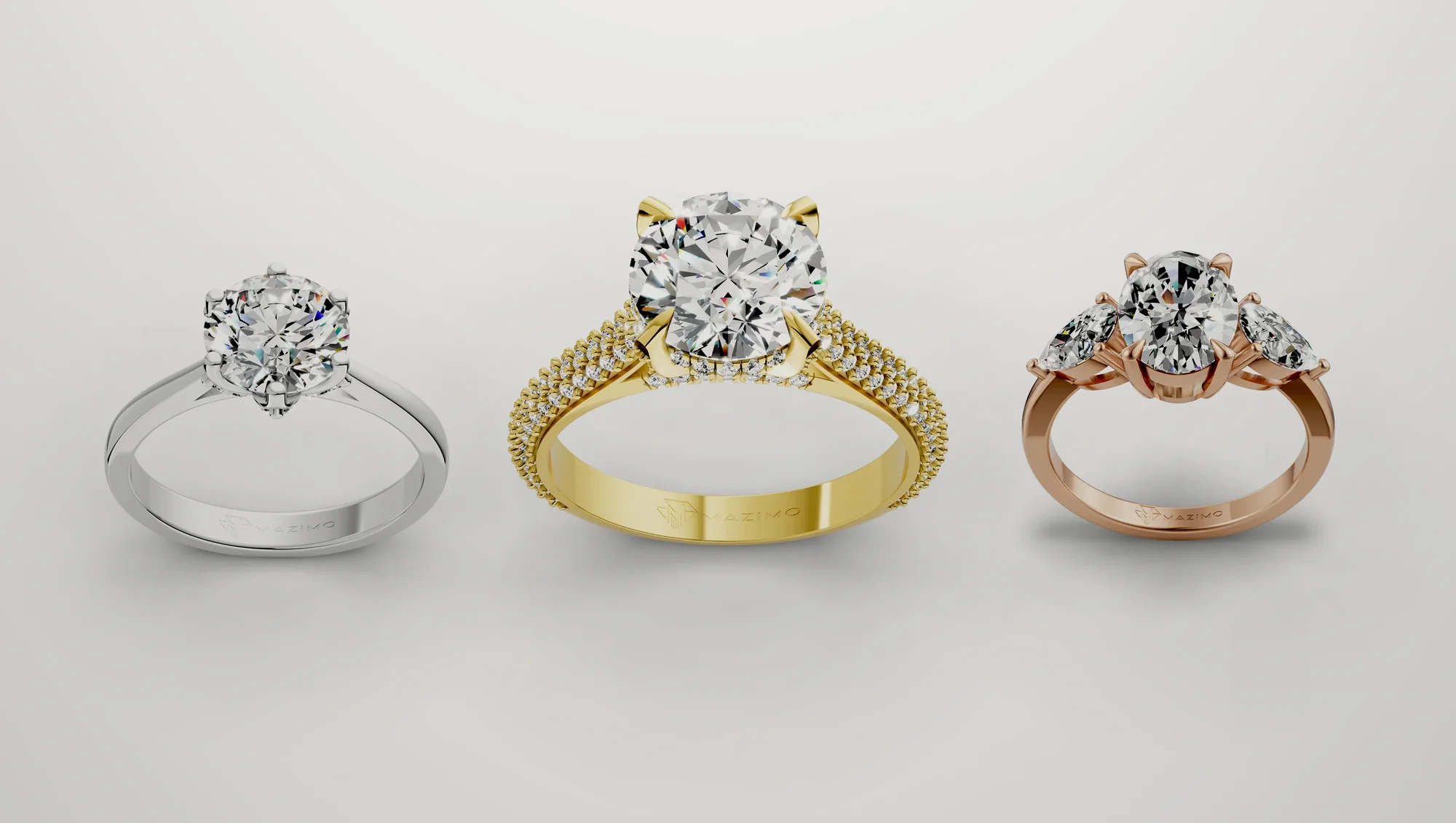
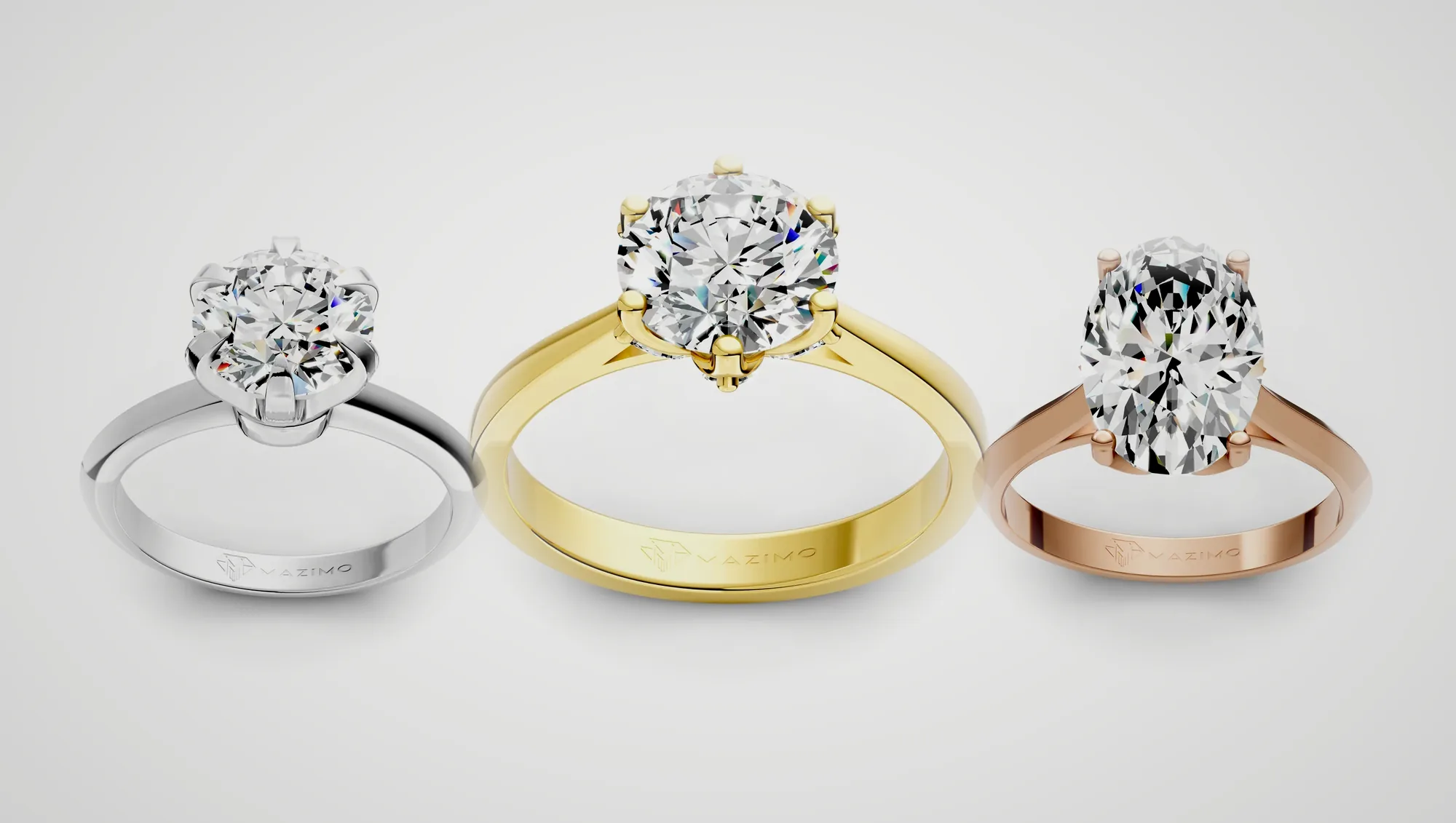
Every Mazimo oval is shown in 18K white, yellow and rose gold from the same five angles, so you can compare like with like. Our guide to yellow, white and rose gold engagement rings covers the colours.
Which wedding band goes with an oval engagement ring?
Our wedding band guide rates a straight band beside an oval solitaire as close or a small gap, using the designer's oval, about 9.7 mm long at 2 ct. A halo or side stones can hold a band further apart, so test the fit with your own ring.
When an oval is not the right choice
An oval is not the right choice if you want an overall GIA cut grade, if you cannot accept any bow-tie, or if you need a straight band to sit flush.
- You want an overall GIA cut grade. GIA gives one only to the round brilliant, though it still reports polish and symmetry for an oval.
- You dislike any bow-tie. GIA says some degree is always present.
- You want the band to sit flush. A halo or side stones can hold a straight band apart: see the wedding band section above.
Oval rings at Mazimo, Dubai
We make 20 oval diamond rings, each to order in 18K white, yellow or rose gold in UAE sizes 46 to 62. Every ring can be made with a natural or a lab grown centre diamond: say which you prefer when you ask for the price on WhatsApp. A grading report accompanies the centre diamond where applicable.
In our designer you can preview an oval solitaire, an oval with marquise shoulders in yellow gold, an oval in a halo or an oval three stone ring at true scale. It shows no price: ask us on WhatsApp which of the 20 rings is closest.
The designer stops at 3.00 ct and draws its own proportions. So it cannot draw the six ovals with the longest centres at their real size: the Oval Side Stone Ring, 10 ct, the Oval Pavé Hidden Halo Ring, 5.5 ct, the Oval Solitaire Ring, 3.5 ct, the Oval and Marquise Three Stone Ring, the Oval Tulip Pavé Solitaire Ring and the Oval Hidden Halo Shoulders Ring.
The boutique is at Al Manal Center, 22 to 26 Deira Street, Naif, Deira, a few minutes from the Gold Souk. Walk in any day, or book a viewing of about 45 minutes, to see and try on our rings, and ask which ovals we can show. The ring pictures below are renders.
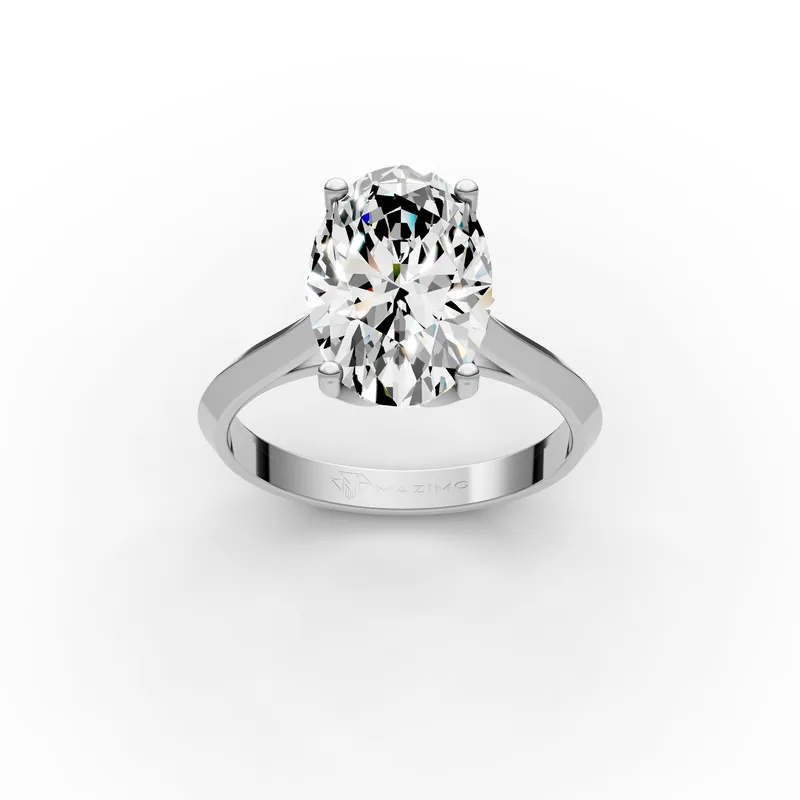 Oval Solitaire Ring, 3.5 ctOval · 18K gold
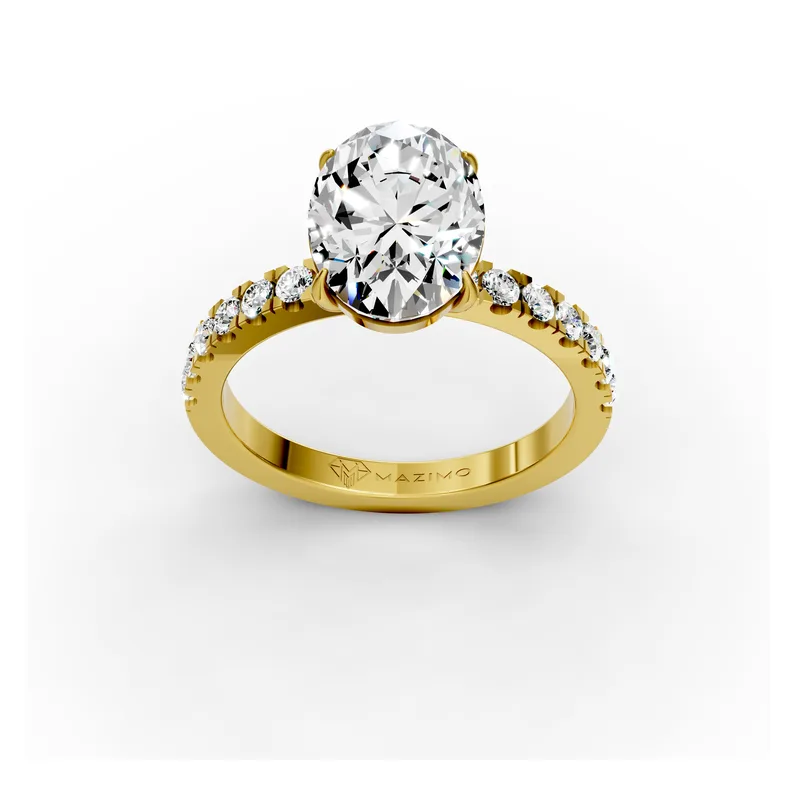 Oval Pavé Solitaire Ring, 2 ctOval · 18K gold
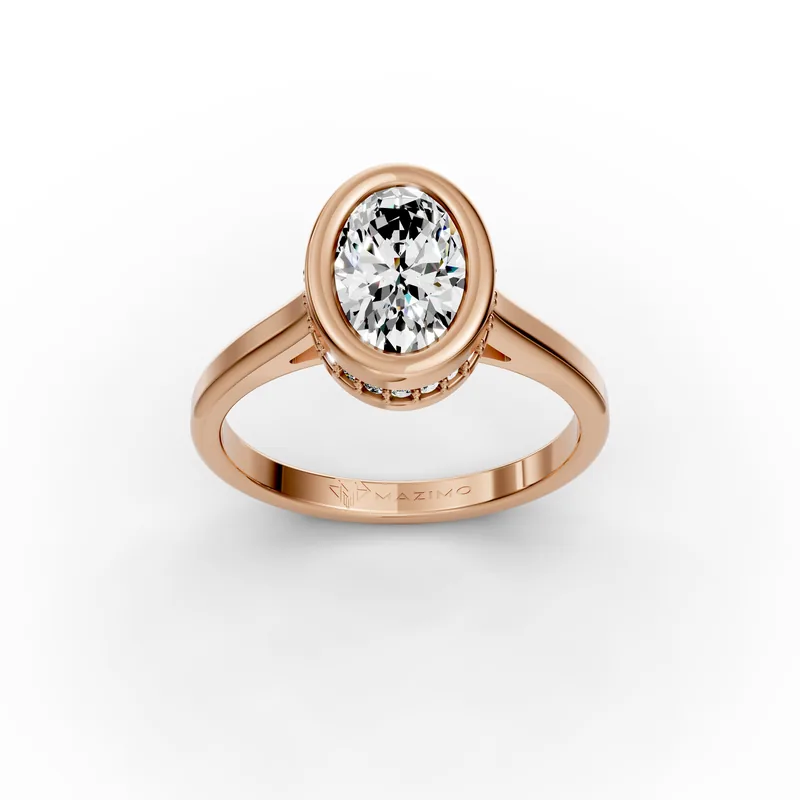 Oval Bezel Solitaire RingOval · 1.5 ct
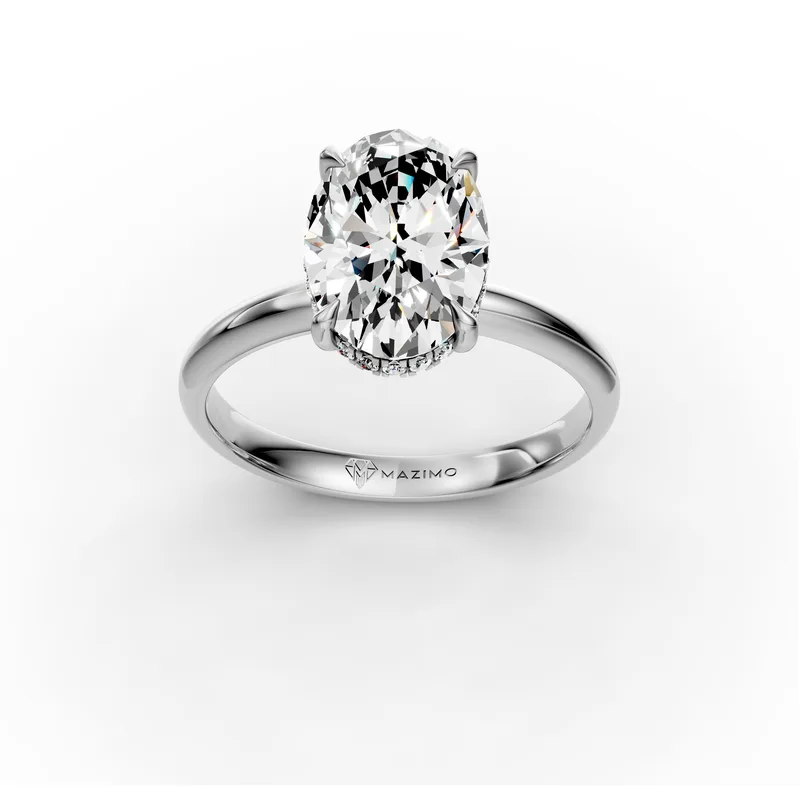 Oval Hidden Halo Solitaire RingOval · 2.5 ct
Questions people ask
What is the ideal length to width ratio for an oval diamond?
GIA gives no single ideal, only bands by look: 1.30 to 1.40 reads rounder and 1.40 to 1.50 is the most popular. Our 20 oval rings measure about 1.38 to 1.55, and 18 of them 1.41 to 1.50.
How big is a 2 carat oval in mm?
About 10 mm long and 7 mm wide, though carat measures weight, not size. Our four rings whose card or name reads 2 ct run about 9.48 to 10.32 mm long and 6.73 to 7.32 mm wide; our designer draws one at about 9.7 × 7.2 mm.
Does an oval look bigger than a round diamond?
At the same carat weight, GIA says yes: an oval's elongated shape gives more surface area than a round. By our arithmetic, treating each outline as an ellipse, the Oval Pavé Solitaire Ring, 2 ct shows about 11 percent more face-up area than the Round Six Claw Solitaire Ring. That compares two rings, not a rule.
Is the bow-tie in an oval a flaw?
GIA says some degree of bow-tie is always present, and a subtle one can add character. It varies even at the same ratio, so GIA advises viewing the actual stone in person or requesting videos.
Which setting suits an oval engagement ring?
GIA says prongs let the most light through, a bezel protects well and a halo makes the stone look larger. We make all three, plus rings with side stones.
Can I try on an oval engagement ring before I order?
Sixteen of our 20 oval rings have a camera try-on, and our designer previews an oval at true scale on a hand. To see rings in person, book a viewing and ask which we can show.
To set the oval beside other shapes, read our diamond shapes guide.