DIAMONDS
27 September 2026
How to Choose a Wedding Band for Your Engagement Ring
Flush, gap or contoured: which engagement rings take a straight band, which need a curved one, and how to match the metal, width and stones of the pair.
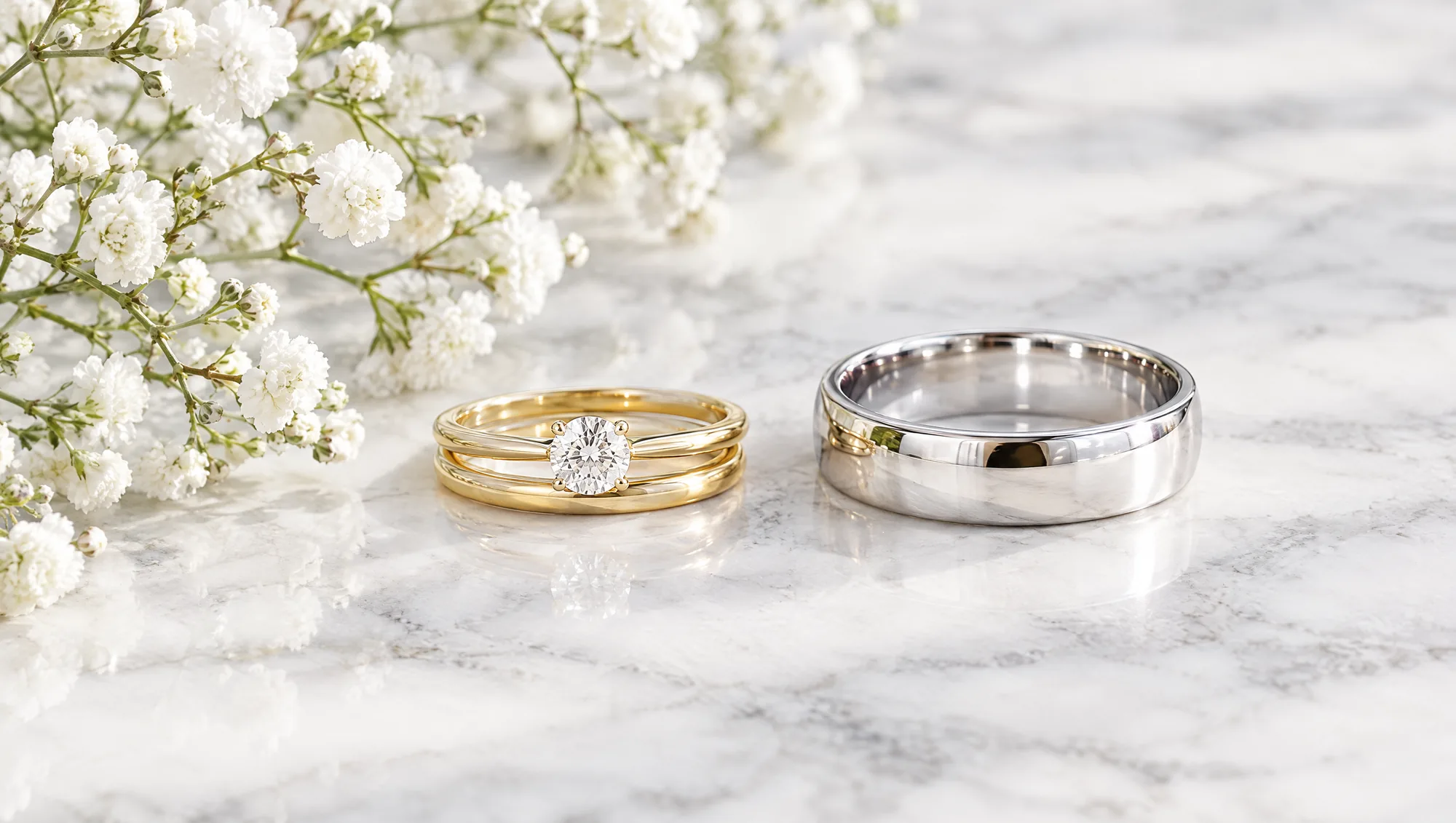
Should the wedding band match the engagement ring? It does not have to, but it does have to sit well beside it, because the two rings share one finger and rub together every day. Agree the karat, the width and the way the band meets the ring, and the style can be whatever you like.
Flush, gap or contoured
- Flush. A straight band touches the engagement ring along its length. Neat, easy to clean, the look most people picture.
- Gap. Something on the ring reaches down to band height and holds a straight band a millimetre or more away. Some like the space; others find the rings twist and rub.
- Contoured. The band is curved or notched to follow the stone or halo, so the two lock together. It closes the gap, but fits that one ring.
It is geometry. Claws, a halo, side stones or a long stone set low push a straight band away, unless the head sits high enough for the band to slide underneath.
Which engagement rings need a shaped band
A useful guide is how far the stone runs along the finger, shown here as approximate face-up lengths from our ring designer. The last column assumes a solitaire; the height of the setting changes it.
| Shape | Length at 1.00 ct | Length at 2.00 ct | Straight band beside a solitaire |
|---|---|---|---|
| Princess | 5.5 mm | 6.9 mm | Usually close |
| Cushion | 6.0 mm | 7.6 mm | Usually close |
| Round | 6.5 mm | 8.2 mm | Usually close |
| Radiant | 6.5 mm | 8.2 mm | Usually close |
| Emerald | 7.0 mm | 8.8 mm | Close or a small gap |
| Oval | 7.7 mm | 9.7 mm | Close or a small gap |
| Pear | 8.5 mm | 10.7 mm | Often a gap: curved band |
| Marquise | 10.5 mm | 13.2 mm | Usually a gap: V-shaped band |
In our designer a halo adds roughly a millimetre on every side, so a 1 ct round in a halo spans nearly 9 mm, a little longer than a 1 ct pear. Three Stone sets a stone either side of the centre, which can hold a band slightly apart. Our engagement ring settings guide compares all five.
A pear usually meets the band with its rounded end, since the point faces the fingertip; a marquise has a point at each end. See a 1 ct pear on a hand at true size, and read our marquise engagement ring guide for more on the shape.
Match the karat, then the width
Keep one karat on one finger. The softer metal wears faster, so a 22K band beside an 18K engagement ring loses its shape first. Every ring from our designer is 18K, so choose an 18K band.
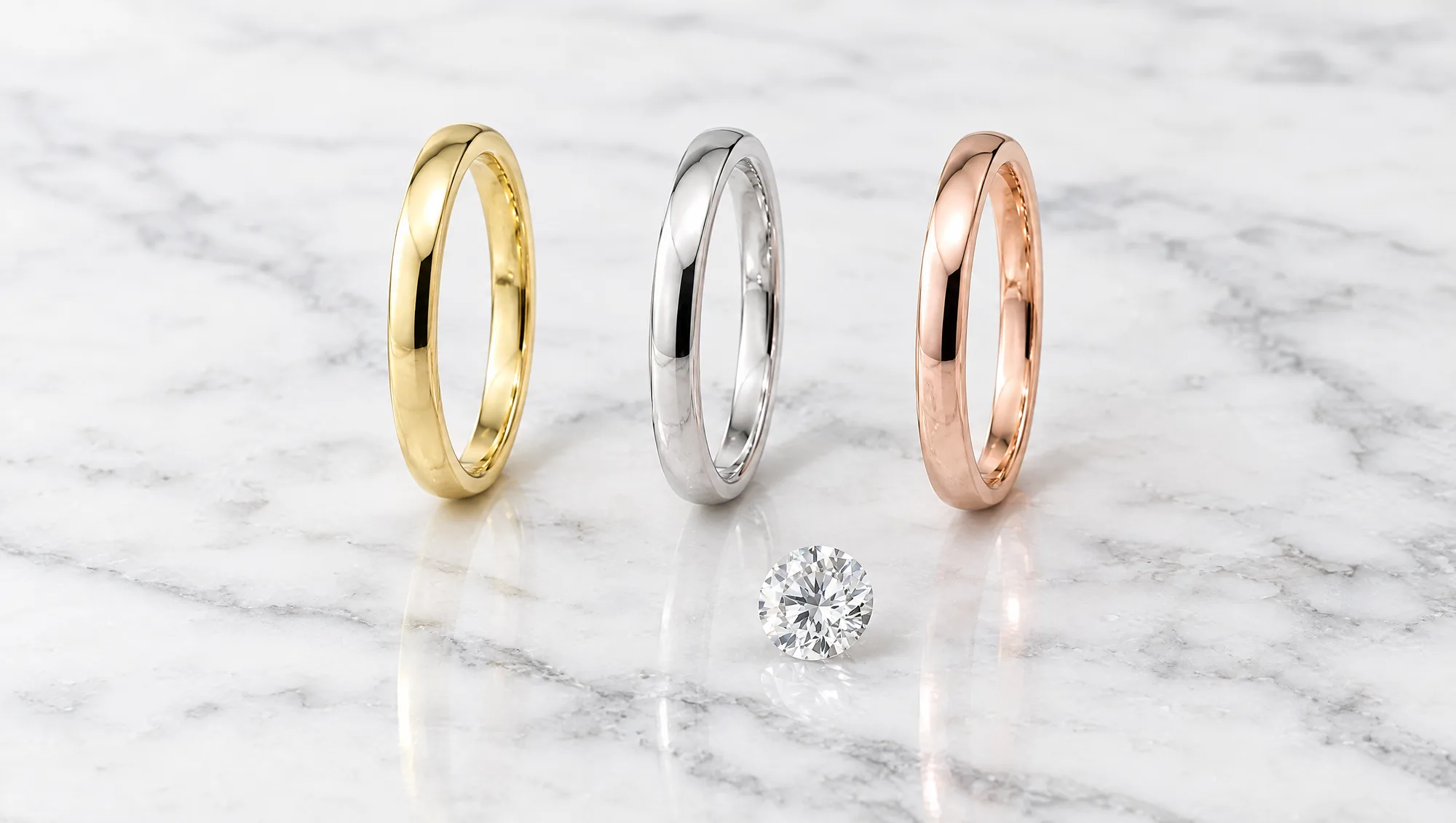
Colour is up to you, but choose it on purpose. White gold is rhodium plated, and where two white rings rub the plating wears first, so replate them together. Our guide to yellow, white and rose gold engagement rings covers the colours.
For width, match the engagement ring's own band or go a little narrower; most bands worn beside an engagement ring are 2 to 3 mm. A much wider band makes the centre stone look smaller.
Plain band or diamonds?
A plain band suits any engagement ring: nothing to catch or lose, and easy to resize. Diamonds add light, but weigh three things first.
- Stone against stone. Diamonds can chip each other and wear the metal holding them. Beside pavé, a halo or the eight marquise diamonds of our Marquise Shoulders, a plain band is kinder to both.
- Half eternity. Stones across the top, plain metal underneath, so it can usually be resized a little.
- Full eternity. Stones all the way round, so it cannot be resized easily and often has to be remade.
Fingers swell in the Dubai heat, so measure at the end of the day, on the finger the rings will share. Our ring size guide gives the UAE size and the inside diameter: size 52 is about 16.5 mm.
Men's bands
Men's bands are usually 4 to 6 mm wide, often with a rounded inside, called comfort fit, that slides over the knuckle more easily. A band over 6 mm sits tighter than a slim one, so go up half a size or try it on at the boutique.
Many Muslim men prefer not to wear gold for religious reasons, and white and rose gold are still gold. Some choose silver or another metal, some wear no band, and it is his decision. If gold is not for him, match the pair another way: the same profile, the same finish, or engravings that answer each other.
Engraving the pair
Our designer takes up to 15 characters inside the band, counting spaces: “A&M 12.02.2027” is 14. Initials, a name or a date fit. A pair can share one message, the date in one ring and the initials in the other. Check the spelling twice: engraved pieces are final sale.
When to buy the band
Choose the band with the engagement ring, but buy it with the finished ring in hand. A plain band can be chosen any time; a curved or V-shaped band must be fitted to the actual ring, or made to follow its outline. Book a private appointment to try them together.
In many Arab families the engagement ring is worn on the right hand until the wedding, then moves to the left. The pair ends up on the left hand, so size both for that finger, and check the engagement ring still feels secure on the right hand in the meantime. Our bridal jewellery checklist sets out the rest.
Questions we hear at the counter
Which goes on first, the band or the ring? Traditionally the band, at the base of the finger. Either works, but with a pear, decide first, since its two ends differ.
Does a contoured band look odd on its own? Worn alone it shows its curve. If you will often wear the band by itself, a straight band with a small gap may suit you better.
Can the rings be resized after the wedding? The first resizing of any Mazimo ring is free. Plain bands move easily; full pavé and full eternity are limited, so get the size right first.
At Mazimo. Design the ring on a hand at true size in our ring designer and send it to us on WhatsApp for the price, or come and see stones and settings at Al Manal Center, Deira, a few minutes' walk from the Gold Souk. Every ring is made in 18K gold, hallmarked in Dubai, and delivered insured across the UAE at no charge.