DIAMONDS
24 October 2026
Three Stone Engagement Ring: Meaning and Side Stone Size
What a three stone engagement ring means, what GIA says about side stone size, and how the side stones on six Mazimo rings compare with the centre.
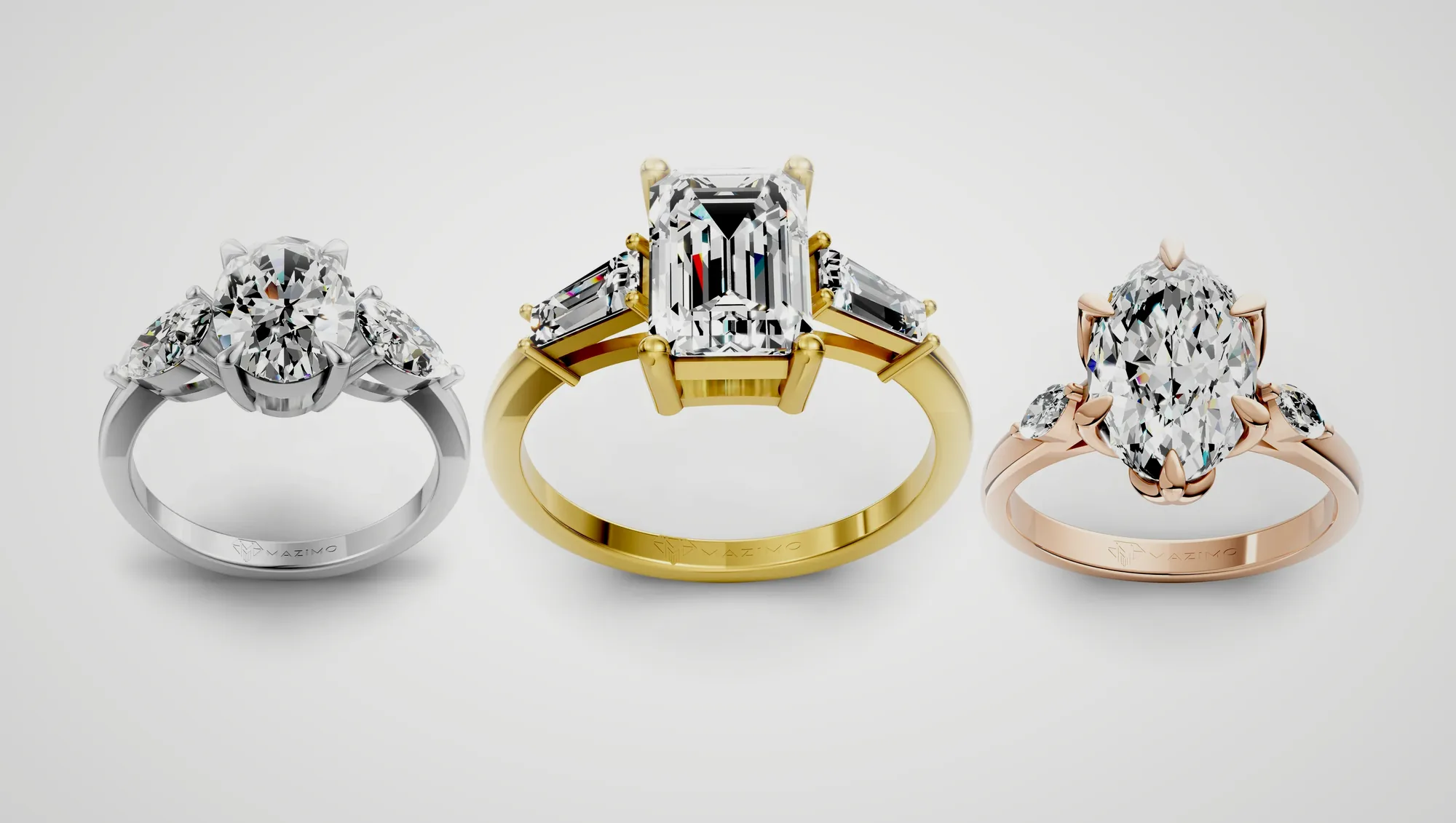
A three stone engagement ring sets one centre diamond between two side stones of the same size or smaller, so the head reads across the finger instead of along it. Its usual meaning, a couple's past, present and future, is a custom: GIA only notes that three stone rings are said to symbolise it. GIA gives no size ratio for the side stones; on our six three stone rings they are 42% to 66% of the centre's length.
At a glance
- GIA's settings guide describes a three stone ring as a centre stone flanked by two smaller side stones (its buying guide allows sides of the same size or smaller), and notes that three stone rings are said to symbolise past, present and future.
- GIA gives no ratio and says side stones should be neither too large nor too small; on our six three stone rings their length is 42% to 66% of the centre's.
- Across the finger, the centre's width plus the two side stones' lengths adds up to about 15 to 21 mm on our rings, before any allowance for gaps and the curve of the finger: about 2.3 to 2.9 times the centre's width alone.
- Five of our six three stone ring pages give the centre stone, the side stones and the total diamond weight on separate lines (the Pavé Ring lists no side stone weight), and we advise asking any seller for all three.
Sources checked 20 October 2026. We read GIA's pages on three stone rings, side stones, settings, three shapes, melee and ring care, a Sotheby's article, a JCK article and one retailer's blog; every ring figure comes from our own ring pages. We did not check IGI, CIBJO or UAE rules and only skimmed museum collections, so the history of the style rests on GIA, Sotheby's and JCK alone.
What is a three stone engagement ring?
A three stone engagement ring has one centre diamond with a smaller stone on each side. GIA's buying guide says a three stone ring typically has side stones of the same size as the centre or smaller, and its settings guide says they can match the centre's cut or differ in shape or colour. Sotheby's says the style is also called a trinity or trilogy ring.
A cluster ring sets a small group on each side instead (see our cluster engagement ring guide). Our settings guide compares the five settings of our designer in one table, and a two stone ring is a different idea (see toi et moi and bypass rings).
Six of our 48 diamond rings are three stone rings: three oval, two marquise and one emerald cut, all made to order in 18K white, yellow or rose gold. Find them with the three stone filter.
Three stone ring meaning: past, present and future?
The usual meaning is a couple's past, present and future, one stone for each. It is a custom, and the sources we read do not trace it to a document.
- GIA (buying guide, 29 November 2018) lists four readings: yesterday, today and tomorrow; friendship, love and fidelity; mother, father and child; and a religious one. It says the style dates to at least the 17th century but names no source.
- Sotheby's (article, 30 September 2024) says the style gained popularity in the Victorian era from the mid 1840s, that the past, present and future idea began to take shape then, and that a 2001 De Beers campaign cemented it.
- JCK, a trade magazine (article, 9 February 2022), says De Beers marketing brought these rings into the spotlight in the early 2000s, presents the past, present and future line as part of it, and gives no date for the style's origin.
The sources do not settle where the meaning came from: Sotheby's places the start of the idea in the Victorian era, JCK ties the line to De Beers marketing without saying when the idea began, and GIA dates the style, not the meaning. None of the three names a primary document. Our reading: treat the meaning as yours to give.
How big should the side stones be?
GIA gives no standard ratio, and we found none in the sources we read. GIA's side stone guide (19 January 2015) says side stones should be neither too large nor too small next to the centre, and should be chosen with the wearer's hand in mind. It prints example carat weights in photo captions but recommends no ratio, size or percentage.
The table divides each side stone's size by its centre's.
| Ring | Centre, about mm (L × W) | Side stones, about mm (L × W) | Side length ÷ centre length, about | Side width ÷ centre width, about |
|---|---|---|---|---|
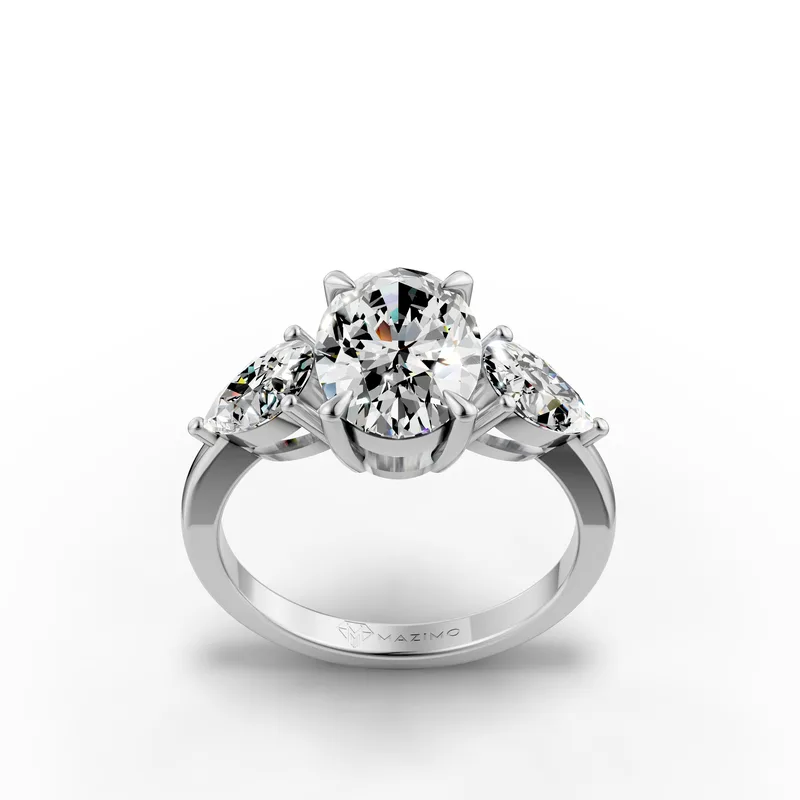
| Oval and Pear Three Stone Ring | 10.32 × 7.32 | 6.80 × 4.36 | 66% | 60% |
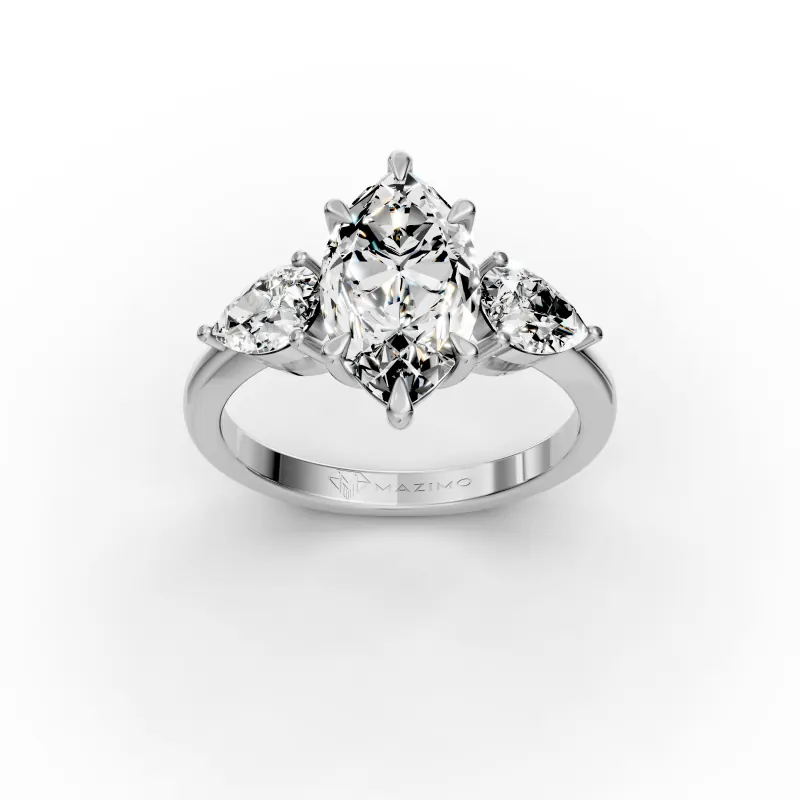
| Marquise and Pear Three Stone Ring, 2 ct | 11.67 × 6.68 | 6.00 × 4.00 | 51% | 60% |
| Marquise and Pear Three Stone Ring, 2.5 ct | 14.47 × 7.28 | 6.80 × 4.36 | 47% | 60% |
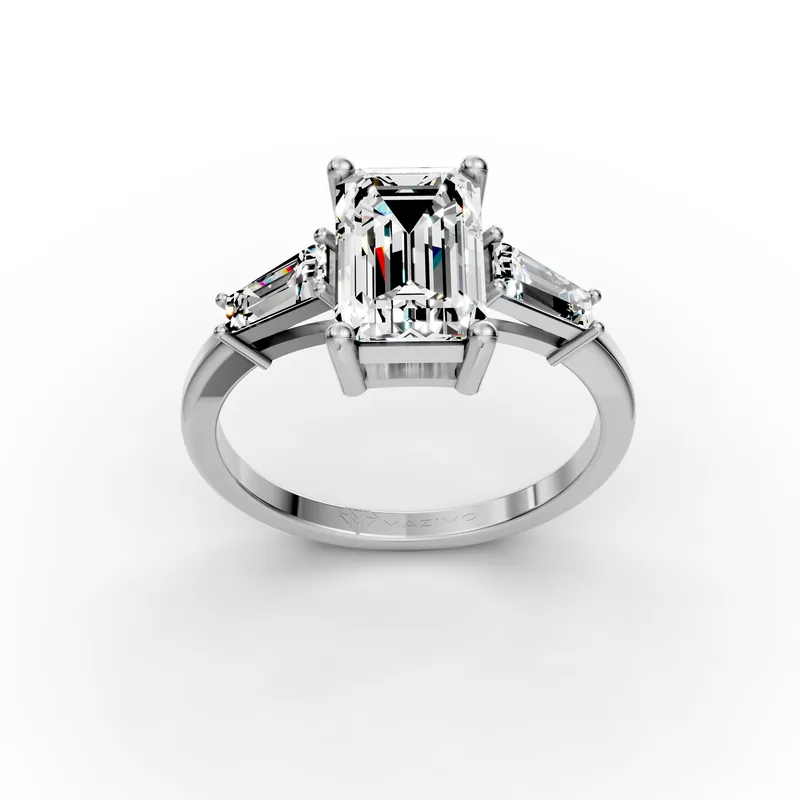
| Emerald and Baguette Three Stone Ring | 8.76 × 5.87 | 5.45 × 2.76 | 62% | 47% |
| Oval and Pear Three Stone Pavé Ring | 9.05 × 6.35 | 4.40 × 3.00 | 49% | 47% |
| Oval and Marquise Three Stone Ring | 12.00 × 8.00 | 5.00 × 2.50 | 42% | 31% |
Sizes are the ones we store; the ring pages round them to one decimal (14.5 × 7.3 mm), so percentages worked out from the page sizes can differ by a point.
The same 6.80 × 4.36 mm pear sits on two rings: it is 66% of the oval's length on one and 47% of the 2.5 ct marquise's on the other (6.80 ÷ 10.32 and 6.80 ÷ 14.47), so judge the pair, not the side stone alone. Where a side stone weight is listed, the pair weighs 0.2 to 0.9 ct against centres of 2 to 3.5 ct.
How wide does a three stone ring sit on the finger?
Wider than a solitaire, because the side stones sit across the finger. On our rings the row of three is about 2.3 to 2.9 times as wide as the centre stone alone (from 18.00 ÷ 8.00 = 2.25 to 20.88 ÷ 7.28 = 2.87).
In the pictures on our ring pages the side stones lie roughly across the finger, angled down the shoulders, so we add the centre's width and two side stone lengths, with no allowance for gaps or claws. Ring by ring, the row measures:
- Oval and Pear Three Stone Ring: 7.32 + 2 × 6.80 = 20.92 mm, about 2.9 times the centre (20.92 ÷ 7.32).
- Marquise and Pear Three Stone Ring, 2 ct: 6.68 + 2 × 6.00 = 18.68 mm, about 2.8 times (18.68 ÷ 6.68).
- Marquise and Pear Three Stone Ring, 2.5 ct: 7.28 + 2 × 6.80 = 20.88 mm, about 2.9 times (20.88 ÷ 7.28).
- Emerald and Baguette Three Stone Ring: 5.87 + 2 × 5.45 = 16.77 mm, about 2.9 times (16.77 ÷ 5.87).
- Oval and Pear Three Stone Pavé Ring: 6.35 + 2 × 4.40 = 15.15 mm, about 2.4 times (15.15 ÷ 6.35).
- Oval and Marquise Three Stone Ring: 8.00 + 2 × 5.00 = 18.00 mm, about 2.3 times (18.00 ÷ 8.00).
The row curves down the sides of the finger, so the width seen from straight above is less, and in the side views the side stones sit lower than the centre. A UAE size 52 ring is 52 mm round, so that finger is about 16.55 mm across (52 ÷ 3.14159). The centre alone covers 35% to 48% of that width (5.87 ÷ 16.55 to 8.00 ÷ 16.55). GIA says side stones should not be hidden by the fingers beside the ring finger, so on a narrow finger check the row first: see our small hands guide. Five of the six rings have camera try-on; the Emerald and Baguette Three Stone Ring does not.
Which shapes work together in a three stone ring?
Side stones can echo the centre's shape or contrast with it. GIA's oval guide says ovals pair well with many side stones: half-moon or oval ones echo the shape, while tapered baguettes add contrast.
- Oval with two pears: the Oval and Pear Three Stone Ring and its pavé version, with the pear points turned outward in the pictures.
- Oval with two marquises: the Oval and Marquise Three Stone Ring.
- Marquise with two pears: the Marquise and Pear Three Stone Ring in 2 ct and 2.5 ct.
- Emerald cut with two tapered baguettes: straight edges throughout. One retailer suggests straight-sided side stones, such as baguettes or trapezoids, for emerald and Asscher centres; see our emerald cut guide.
The six rings use only oval, marquise and emerald centres. Our ring designer previews the Three Stone setting at true size in eight centre shapes: round, oval, cushion, pear, marquise, emerald, princess and radiant. It draws its own proportions, so ask which finished ring is closest.
See our oval, marquise and pear guides.
 Oval and Pear Three Stone RingOval · 2 ct
 Marquise and Pear Three Stone Ring, 2 ctMarquise · 2 ct
 Emerald and Baguette Three Stone RingEmerald cut · 2 ct
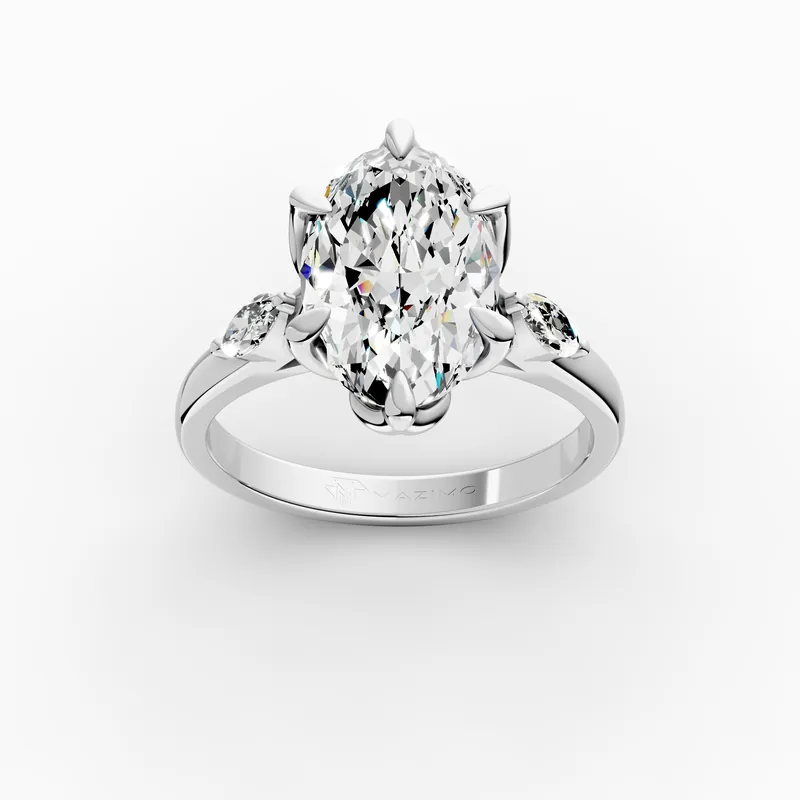 Oval and Marquise Three Stone RingOval · 3.5 ct
Matching colour, clarity and weight across three stones
GIA says the side stones of an all diamond three stone ring should typically sit within about two colour grades of the centre, and much whiter side stones can make the centre look more yellow. Clarity should be similar but need not be identical, says its buying guide.
GIA calls diamonds under a fifth of a carat melee, a range it says varies by country and trade segment, and describes their colour and clarity in broad bands (our cluster guide covers this). The two marquises on our Oval and Marquise Three Stone Ring weigh 0.2 ct together, so each is below GIA's line; the other pairs we list weigh 0.5 to 0.9 ct.
GIA's side stone guide suggests a GIA Diamond Grading Report or Diamond Dossier as an unbiased check but does not say each side stone needs its own, so ask which stones a report covers. Our GIA report guide and IGI report guide explain each.
We can set natural or lab grown diamonds in any of these rings (our comparison); tell us which you prefer. Our ring pages state no colour, clarity or origin, so ask us on WhatsApp which grades apply, and have the invoice state the count, size and weight of each stone and whether each is lab grown or natural.
Weight needs care. Five of our six pages list the centre, the side stones and the total on separate lines (the Pavé Ring lists no side stone weight): the Oval and Pear Three Stone Ring is a 2 ct oval, 0.9 ct of pears and 3 ct in all. Our pages round weights of 1 ct and over up to the half carat above, so the parts need not add: the Oval and Marquise Three Stone Ring lists a 3.5 ct centre, 0.2 ct of side stones and 3.5 ct in all. Ask for the centre's weight and the side stones' weight, not only a total.
Claws, points and wear
A three stone ring has three stones to keep secure, and GIA recommends having prongs checked about every six months, or yearly if that seems too often. It says to take the ring off before gardening or other risky activities, lists exercise among the things that can take their toll, says washing dishes with it on is not ideal, and suggests cleaning it with warm water, mild soap and a soft toothbrush (see our cleaning guide). Our warranty page lists lifetime cleaning and polishing at the boutique and an annual check of the settings on diamond pieces, which fits GIA's yearly option.
- Points. GIA says the point is the weakest part of a pear and the pointed ends the most vulnerable part of a marquise, and suggests a V-prong or a bezel. Five of our six rings have pear or marquise side stones; our pages do not say how each point is protected, so ask.
- Bezel. GIA's three stone guide recommends a bezel for active wearers. None of our six pages describes a bezel setting; see our bezel and claw guide.
- Resizing. Four of our pages list a plain band, which in our view has no small stones to disturb. The Oval and Pear Three Stone Pavé Ring lists small stones along the band and does not say how far they run, and GIA says pavé bands can be harder to resize; the Emerald and Baguette page does not describe its band. The first resizing of a Mazimo ring is complimentary, and only the first, under the warranty, so give us your size before the ring is made; see can a diamond ring be resized.
Three stone, solitaire, cluster or halo?
Choose a three stone ring for width across the finger and a story, and a solitaire for less upkeep. GIA says that with diamonds of equal size and quality a three stone ring has more sparkle than a solitaire, but asks what happens when the cut grades differ or the stones are not round brilliants, and says GIA grades cut only on round brilliants. All six of our rings use other shapes, which that guide says get no GIA cut grade, so judge the sparkle by eye and ask whether a report covers the centre stone and what it says. GIA also asks whether the same money could buy a significantly larger solitaire; our reading is that this is the real trade-off, and our cost guide shows how to compare quotes (we give no prices here).
| If you want | Look at | Why | Watch |
|---|---|---|---|
| Less upkeep | Solitaire | One stone and fewer claws | The centre carries all the size |
| Width across the finger and a story | Three stone | On our rings the row is about 2.3 to 2.9 times the centre's width | Pointed side stones need protecting |
| Small sparkle at the sides, the centre's outline clear | Cluster | Our two clusters set three rounds of about 2.00 mm each side | Six small stones to clean |
| A centre that can look larger | Halo | GIA says a halo can make the stone appear larger | GIA says it may need more maintenance |
Questions people ask
What does a three stone engagement ring mean?
Most often past, present and future. GIA reports that three stone rings are said to symbolise this, and lists other readings: friendship, love and fidelity, or mother, father and child. It is a custom, not a rule.
Is a three stone ring an engagement ring?
Yes. GIA, Sotheby's and JCK each write about it as an engagement ring style, and we read no rule in them that an engagement ring must be a solitaire. For which hand to wear it on, see our guide to which hand in the UAE.
Should the three stones be the same size?
We found no rule that says so, and GIA says side stones may be the same size as the centre or smaller. GIA gives no ratio. On our six rings they are 42% to 66% of the centre's length; if you want them closer in size, ask us on WhatsApp what is possible.
Can I wear a wedding band with a three stone ring?
Yes, but plan the band first. Our wedding band guide says a stone on each side of the centre can hold a straight band slightly apart; a contoured band closes the gap but fits only that ring. Check both before the ring is made.
What is a trilogy ring?
A trilogy ring is another name for a three stone ring: a centre stone with one stone on each side. Sotheby's says it is also called a trinity ring.
How much does a three stone engagement ring cost in Dubai?
It depends on the diamonds, the gold and the setting, so we give no figure here. Each ring's page shows its price: see the three stone rings, and our engagement ring cost guide for how to compare quotes.
At Mazimo. Our three stone rings are made to order in 18K gold in UAE sizes 46 to 62, hallmarked in Dubai and delivered insured across the UAE at no charge. Try the Three Stone setting in our ring designer and ask for the price on WhatsApp, or come to Al Manal Center in Deira, minutes from the Gold Souk. For small stones at the sides instead, read our cluster ring guide.