DIAMONDS
27 September 2026
Lab-Grown vs Natural Diamonds: An Honest UAE Comparison
Only a laboratory can tell them apart, so the report and invoice must. What to check on each, how resale compares, and which diamond suits which buyer.
Many couples who come to our counter have already chosen a shape and a budget. What they have not settled is where the diamond should come from: a mine or a laboratory. Both are real diamonds and neither is the wrong answer, but they differ in rarity, resale, paperwork and how far your budget goes.
What a lab-grown diamond is
A lab-grown diamond is diamond: carbon in the same cubic crystal as a mined stone, with the same hardness of 10 on the Mohs scale, the same refractive index of 2.42 and the same fire. It is cut and polished like any other diamond.
It is grown in one of two ways. HPHT (high pressure, high temperature) crystallises carbon from molten metal onto a small diamond seed inside a press. CVD (chemical vapour deposition) grows it on thin diamond plates from heated hydrogen and methane, a few atoms at a time. HPHT takes days to weeks, CVD three or four weeks. A natural diamond formed some 150 to 250 km underground, usually more than a billion years ago.
Moissanite and cubic zirconia are something else: simulants, softer materials with more rainbow flash.
Can anyone tell them apart?
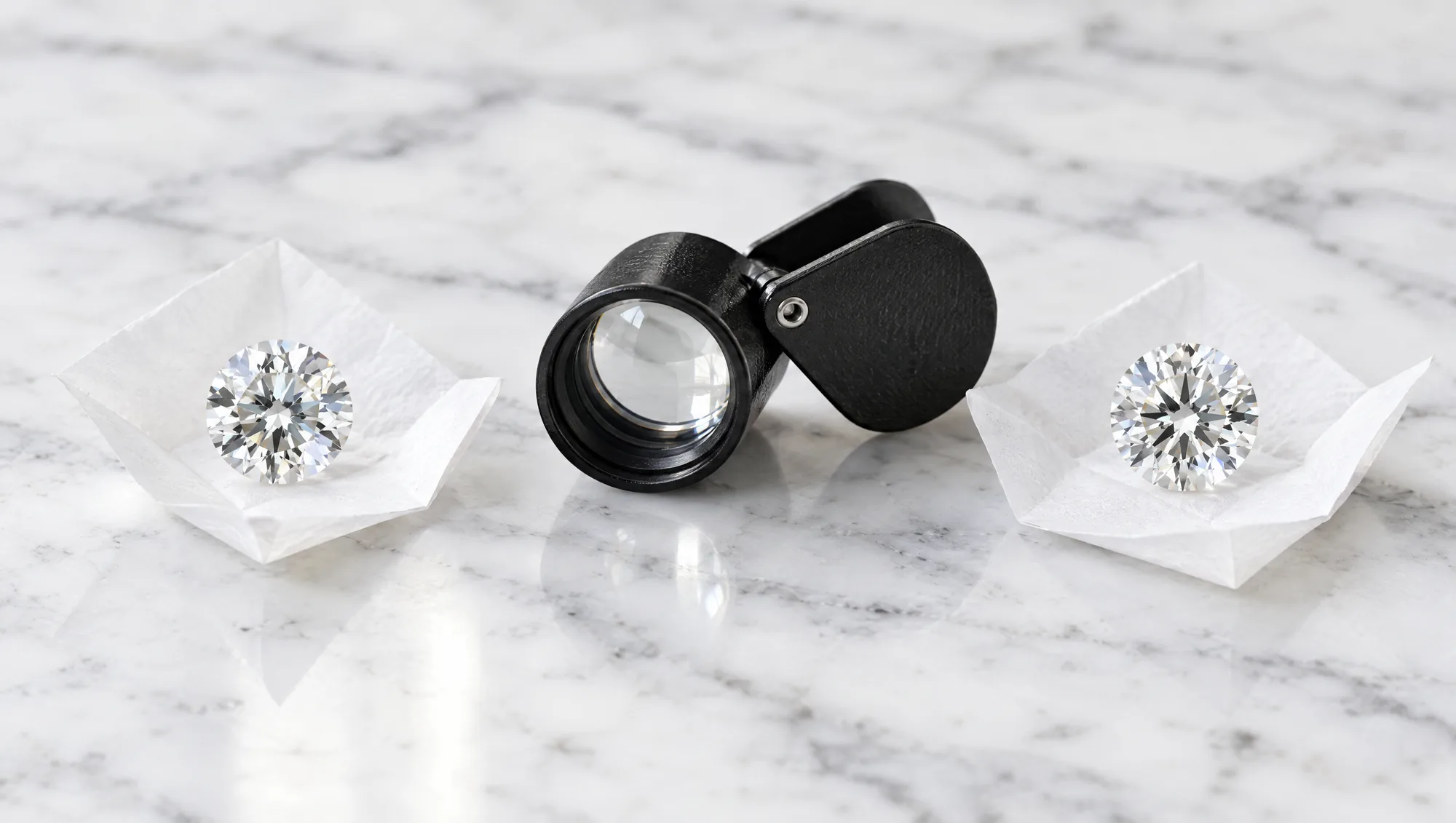
Not by eye, and not reliably with a loupe. A standard handheld tester, which measures how a stone conducts heat, reads both as diamond, because both are.
Separating them takes laboratory instruments that read growth patterns and trace elements. About 98% of natural diamonds contain nitrogen grouped in pairs or clusters of atoms, while colourless lab-grown stones contain little or none. Dubai Central Laboratory, part of Dubai Municipality, has said it is equipped to detect lab-grown stones. You cannot check origin yourself, so the paperwork has to.
Disclosure: what the report and invoice should say
- The grading report. A lab-grown stone's report says so on its face, and should note any treatment after growth: many CVD stones are heat-treated after growth to improve their colour. IGI, which grades the majority of certified lab-grown diamonds, uses the same D to Z colour and FL to I3 clarity scales as for natural stones. Since October 2025, GIA no longer gives lab-grown stones colour and clarity grades; its reports place them in one of two categories, Premium or Standard.
- The laser inscription. Graded stones often carry the report number on the girdle. IGI adds "LG" before the number on every lab-grown stone it grades, and GIA inscribes the words "Laboratory-Grown". Ask to see it under magnification and check it matches the report.
- The invoice. It should say "lab-grown" or "laboratory-grown" beside the stone, not just "diamond". If the wording is vague, have it corrected before you pay.
A design sent from our ring designer names the centre stone as lab-grown or natural, so the choice is in writing from the start. Our guide to diamond certificates in Dubai reads a report line by line.
Value and resale: the honest part
Natural diamonds are rare, and the trade pays for rarity. A good natural stone with a respected report can usually be resold, though well below the shop price. Treat that as a cushion, not an investment.
Lab-grown diamonds are not rare. Factories can grow more whenever demand rises, and prices have fallen steadily, which suits today's buyer but not a future seller. Resale value is minimal; many dealers will not make an offer at all.
What your budget buys on each side
Prices depend on the exact stone and move with the market, so we quote them on WhatsApp. For the same budget, lab-grown usually buys a larger stone, a whiter colour and a higher clarity, or some of each. With natural you tend to choose between size and grade, and our 4Cs guide shows which grades are worth paying for.
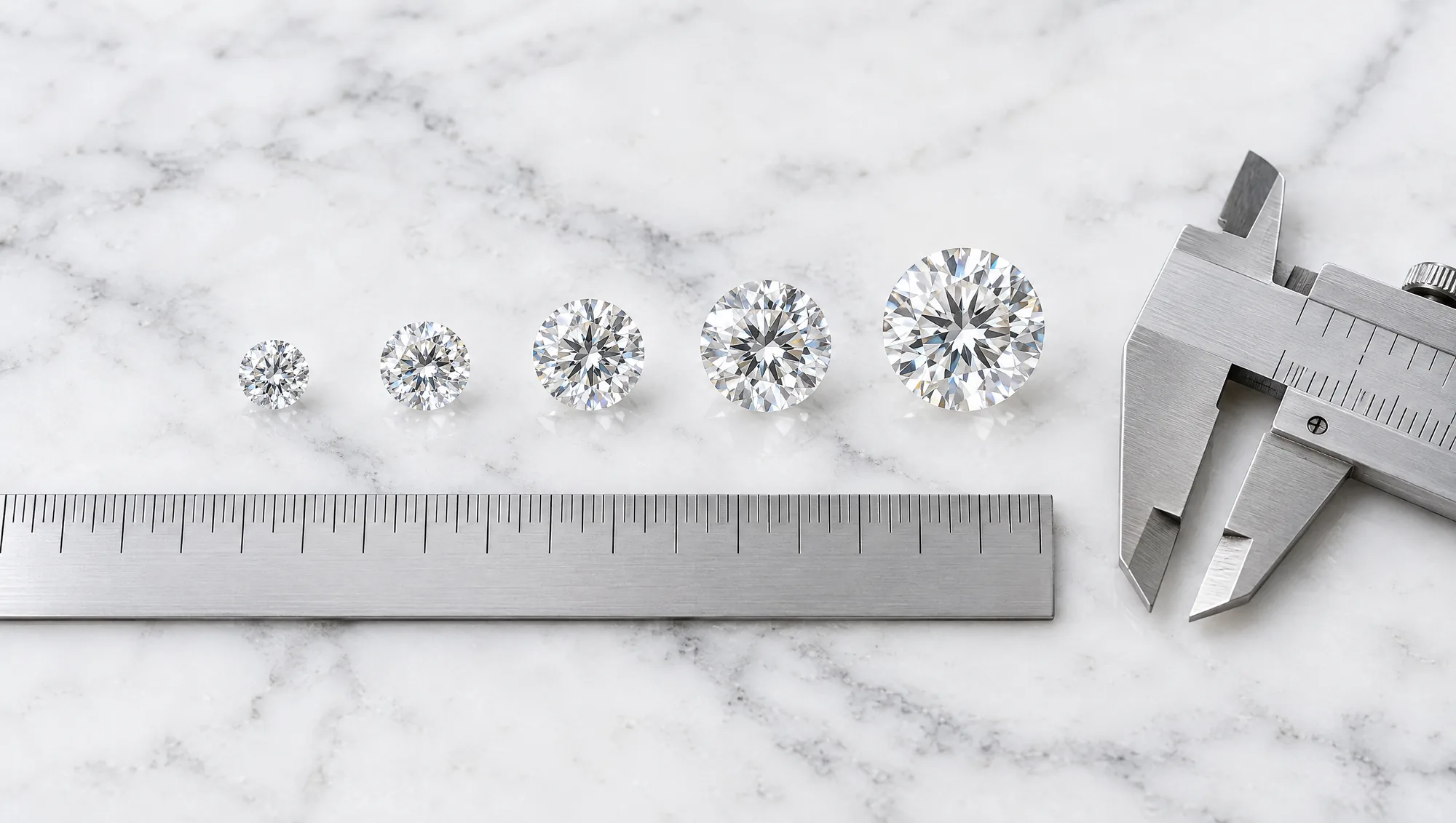
A step up in weight shows on the hand. A 1.00 ct oval measures about 7.7 × 5.7 mm face-up, a 1.50 ct about 8.8 × 6.5 mm and a 2.00 ct about 9.7 × 7.2 mm. The diamond size chart covers every shape.
Lab-grown and natural side by side
| Lab-grown | Natural | |
|---|---|---|
| Material | Carbon, cubic crystal | Carbon, cubic crystal |
| Hardness (Mohs) | 10 | 10 |
| Appearance | Identical at the same quality | Identical at the same quality |
| How it forms | Days to weeks, by HPHT or CVD | Underground, over geological time |
| Telling them apart | Laboratory only | Laboratory only |
| Supply | Grown to demand | Finite |
| Size and grade per budget | More | Less |
| Resale | Minimal | Some, well below retail |
Ethics: read the claims carefully
Both sides sell on ethics, and both claims deserve a question. Rough diamonds entering or leaving the UAE fall under the Kimberley Process, the certification scheme against conflict diamonds, which the UAE chaired in 2024. It certifies shipments of rough diamonds as they cross borders; it does not answer every labour or environmental question.
Lab-grown stones avoid mining, but growing them takes a great deal of electricity, and the footprint depends on where that power comes from. Ask for specifics, not adjectives.
Who each one suits
Lab-grown suits you if you want the most size and brightness for your budget, you will wear the ring rather than sell it, and looks matter more than rarity. It is the default in our designer.
Natural suits you if age and rarity mean something to you, if you want the stone to keep some resale value, or if the ring is meant to pass down.
You do not have to decide in the abstract. Build a 1.50 ct lab-grown oval solitaire in 18K white gold, then switch only the diamond to see the same ring with a natural stone. Nothing else changes.
Questions we hear at the counter
Is a lab-grown diamond a real diamond? Yes. Same material, same hardness, same sparkle. Only its origin differs, which is why the report and invoice must state it.
Will a lab-grown diamond go cloudy? No. Both are stable carbon crystals. A dull stone usually means oil and soap under it, which a clean removes; our care guide explains how.
Can I get a price for both? Yes. Send both versions of your design on WhatsApp and ask for a price on each. We reply daily 10:00 to 22:00.
At Mazimo. Design the ring on a hand at true size in our ring designer and send it to us on WhatsApp for the price, or come and see stones and settings at Al Manal Center, Deira, a few minutes' walk from the Gold Souk. Every ring is made in 18K gold, hallmarked in Dubai, and delivered insured across the UAE at no charge.