DIAMONDS
27 September 2026
IGI vs GIA Diamond Reports: What to Check Before You Buy
Read a diamond grading report line by line, check the laser inscription and the report number online, and spot the red flags on a Dubai invoice.
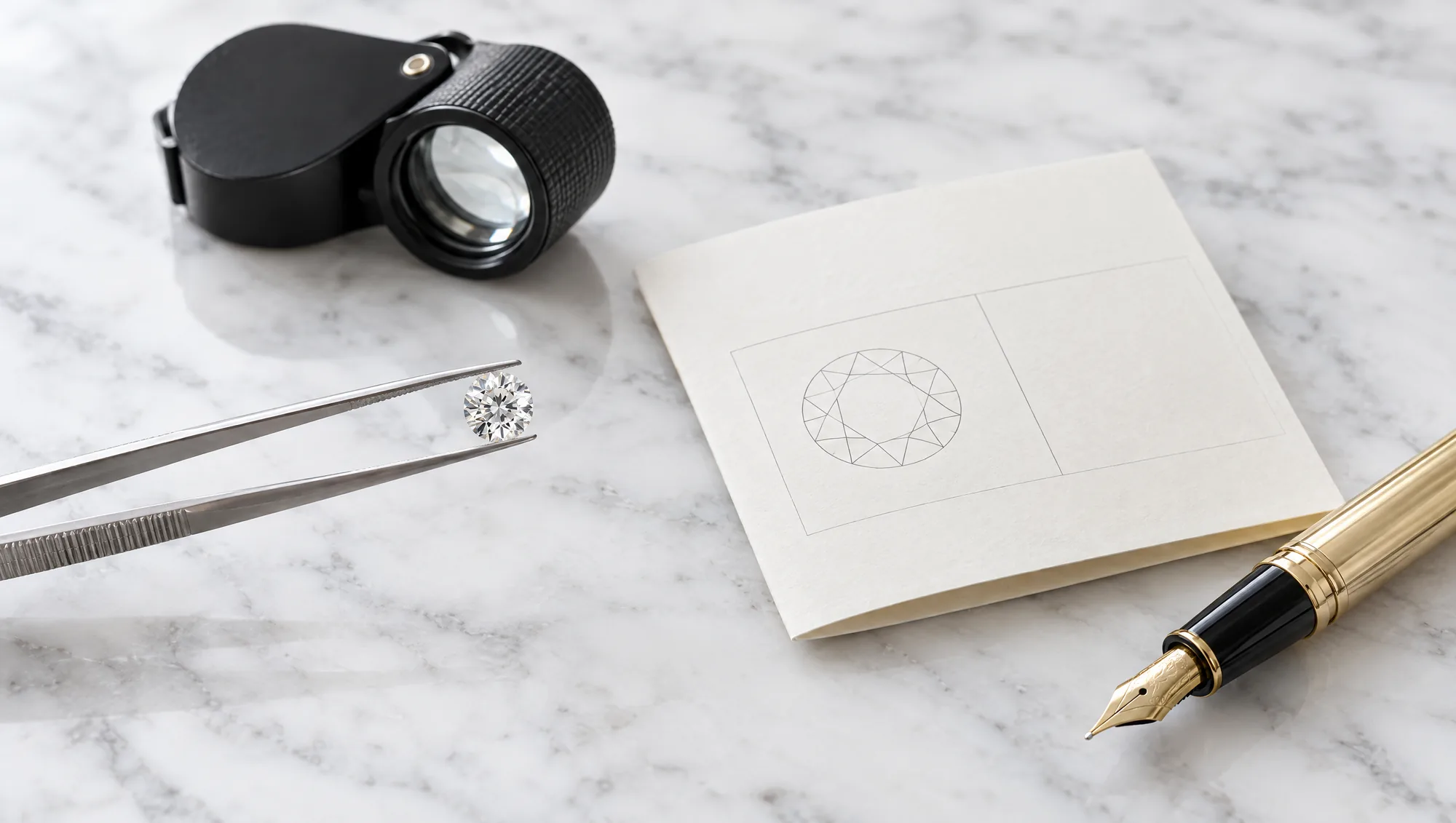
A diamond in Dubai usually comes with a paper, and the question at the counter is always the same: is IGI as good as GIA, and how do I know this paper belongs to this stone? A grading report is worth something only when you can check it, it matches the stone in front of you and it agrees with the invoice.
GIA and IGI: who grades what
The Gemological Institute of America (GIA), founded in 1931, created the D to Z colour scale. For natural diamonds, its reports are the benchmark much of the trade works from.
The International Gemological Institute (IGI), founded in Antwerp in 1975, grades most of the lab-grown diamonds that are sold with a report, on the same D to Z colour and FL to I3 clarity scales used for natural stones. It grades natural diamonds too.
Neither lab sells diamonds, and a report is not a valuation: it records what the lab saw, with no price.
GIA's 2025 change for lab-grown stones
Since 1 October 2025, GIA's reports on colourless and near-colourless lab-grown diamonds give no colour or clarity grade. Each stone is placed in one of two descriptive categories:
- Premium. D colour, VVS clarity or better, Excellent polish and symmetry, and an Excellent cut on round brilliants.
- Standard. Colour J or better, VS clarity or better, at least Very Good polish and symmetry (Good symmetry on fancy shapes), and at least a Very Good cut on round brilliants.
Stones below that receive no assessment. So if a seller quotes GIA colour and clarity grades, such as "E VS1", for a lab-grown stone, look at the report date: a GIA report issued since that change does not give them.
| GIA | IGI | |
|---|---|---|
| Best known for | Natural diamonds | Lab-grown diamonds |
| Natural stones | Colour D to Z, clarity FL to I3 | Colour D to Z, clarity FL to I3 |
| Lab-grown stones | Premium or Standard (since October 2025) | Colour D to Z, clarity FL to I3 |
| Lab-grown inscription | "Laboratory-Grown" and the number | "LG" and the number |
| Online check | Report Check, gia.edu | Verify Your Report, igi.org |
Reading a report line by line
- Number and date. The number is what you verify. The date tells you whether a GIA lab-grown report uses grades or categories.
- Origin. A lab-grown report says "laboratory-grown" on its face, and usually notes whether the stone was treated after growth.
- Measurements. Given to a hundredth of a millimetre. A 1.00 ct round is about 6.5 mm across, a 1.00 ct oval about 7.7 × 5.7 mm; our diamond size chart covers every shape.
- Carat weight. Two decimals. A 0.98 ct and a 1.00 ct stone look almost identical, so check the exact figure.
- Colour, clarity and cut. GIA gives an overall cut grade only on round brilliants, and IGI on rounds and some fancy shapes. Where there is none, read the polish and symmetry grades. Our 4Cs guide explains which grades are worth paying for.
- Plot and comments. Where the report has a plot, it maps the inclusions, a fingerprint of that one stone.
Match the paper to the stone
A genuine report for a different diamond is an old trick. Two checks close it.
First, the laser inscription. GIA inscribes the report number on the girdle, the thin edge around the widest point, of every lab-grown stone it assesses. IGI lab-grown stones are normally inscribed too, and many natural stones are, although for them it is optional. You need a 10x loupe at least; ask the jeweller to show you and read every digit against the report. On an IGI lab-grown stone, look for LG before the number. A prong can hide part of it once set, so check before setting.
Second, the online record. Enter the number on the lab's own website and compare weight, measurements and grades. Type the lab's address yourself rather than trusting a link or QR code printed on the paper. Save the result with your invoice.
"Laboratory-grown" on the invoice too
Only laboratory instruments can reliably tell lab-grown from natural, so the origin has to be in writing twice. Our guide to lab-grown and natural diamonds sets out how they differ.
The invoice should name the lab, the report number, the shape, the weight, the grades exactly as the report gives them, and "lab-grown" or "laboratory-grown" beside the stone. "Diamond" alone is not enough. A design from our ring designer states the origin in the message it sends us, whether you build a 1.00 ct lab-grown round solitaire in 18K white gold or the same ring with a natural diamond.
Small pave and halo stones are rarely graded one by one. The invoice should give their total weight and their origin.
Red flags
- A lab you cannot find. An unknown name, a lab tied to the seller, or no online record.
- Grades that differ between papers. If the invoice says G VS1 and the report says H VS2, go by the report, and the price should follow it.
- Numbers that do not match. A weight or measurement that differs from the stone, or an inscription that is missing or different.
- Vague origin. A lab-grown stone described only as "diamond".
- No time to look. A seller who will not let you check the inscription or the number before you pay.
A gold certificate is not a diamond report
A certificate of purity covers the metal: the karat and the weight in grams, backing up the hallmark inside the ring, 750 for 18K gold. It says nothing about a stone's colour, clarity or origin.
A diamond ring has two documents doing two jobs. Our guide to what a gold certificate must say covers the first, and every Mazimo certificate of purity carries a tracking code you can check at mazimo.ae/track. The stone's grading report is the second.
Questions we hear at the counter
Is IGI as good as GIA? For lab-grown diamonds, IGI is the usual report and still gives full grades. For natural diamonds, GIA is the benchmark. Either beats a paper you cannot check.
Did GIA stop grading lab-grown diamonds? Not entirely. Since October 2025 it assesses colourless and near-colourless ones as Premium or Standard, without individual colour or clarity grades.
Does every diamond in Dubai come with a report? Not necessarily. The hallmark on the gold is required; a report for the stone is something to ask for, and check, before you choose it.
At Mazimo. Design the ring on a hand at true size in our ring designer and send it to us on WhatsApp for the price, or come and see stones and settings at Al Manal Center, Deira, a few minutes' walk from the Gold Souk. Every ring is made in 18K gold, hallmarked in Dubai, and delivered insured across the UAE at no charge.