DIAMONDS
27 September 2026
Diamond 4Cs Explained: Which C Matters Most and Why
Cut, colour, clarity and carat in plain terms: the grade scales in one table, what eye-clean means, and where to spend or save on an engagement diamond.
Every diamond is described by four measures: cut, colour, clarity and carat. Most people at our counter know the words and ask which one is worth paying for. Our answer: cut first, then size, with colour and clarity bought only as far as the eye can see.
Cut: the C you see across a room
Cut is not the shape. It is how well the facets return light as brightness, fire and sparkle: the C that depends most on the cutter rather than on nature, and the one that changes the look most.
Round brilliants are graded Excellent down to Poor, and some labs add Ideal on top. A well-cut round typically has a table of about 54 to 57% and a depth of about 59 to 62.5%. Cut deep to hold weight, a 1.00 ct round can measure about 6.2 mm instead of about 6.5 mm: weight you pay for and never see.
Fancy shapes have no GIA cut grade
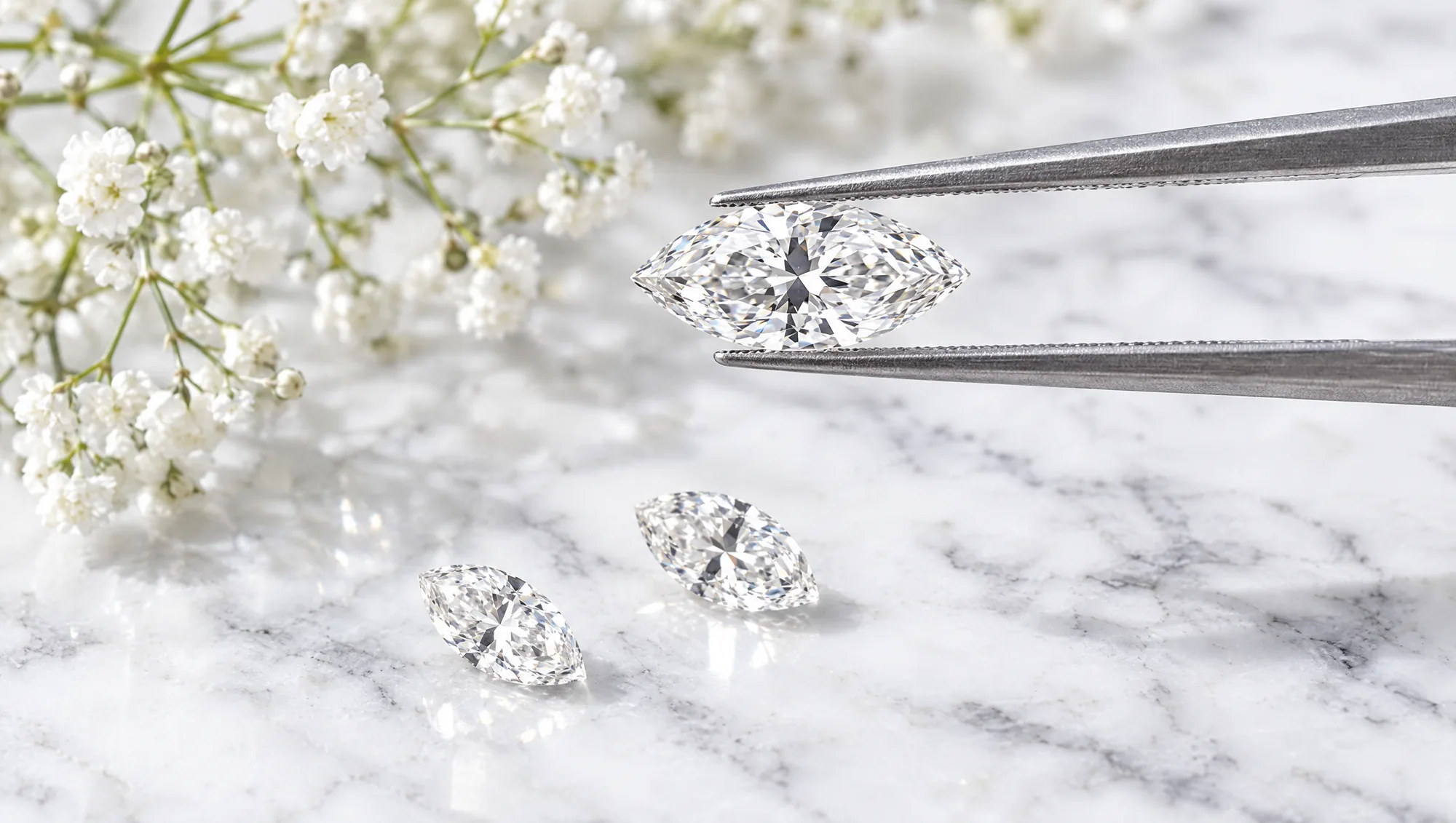
GIA gives a cut grade only to rounds. For the other seven shapes in our designer, a GIA report gives polish and symmetry; IGI has offered a cut grade for many fancy shapes since 2022, but no single grade tells you how a fancy shape looks. Your eye does the rest: look for even brightness and only a faint bow-tie, the dark band across some ovals, pears and marquises. Our diamond shapes guide covers each outline.
Colour: D to Z
D, E and F are colourless, G to J near colourless, K to M faint, and N to Z increasingly yellow or brown. Grading is done face-down against master stones; face-up and set, one grade apart is hard to see. Colour shows more in bigger stones, at the tips of elongated shapes and in emerald cuts; rounds hide it best.
Why yellow and rose gold forgive colour
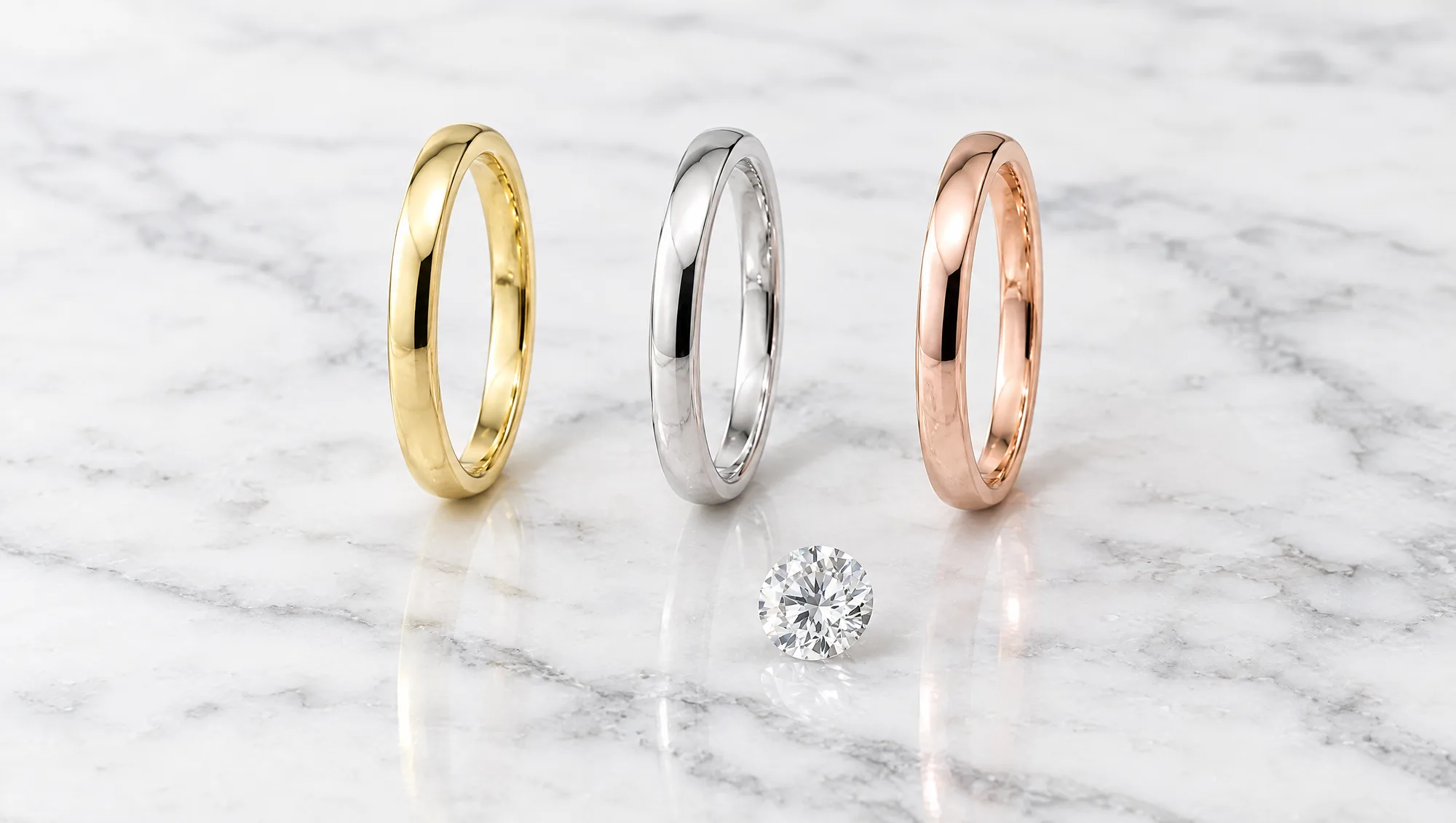
A diamond picks up the colour around it. Warm yellow or rose gold reflects into the stone, so a near-colourless diamond reads as white, while bright, rhodium-plated white gold shows any warmth by contrast. As a starting point, aim for G or H in white gold and H to J in yellow or rose.
Set a 1.50 ct oval solitaire in 18K yellow gold, then switch to white to compare. Our guide to yellow, white and rose gold goes further.
Clarity: FL to I3, and what eye-clean means
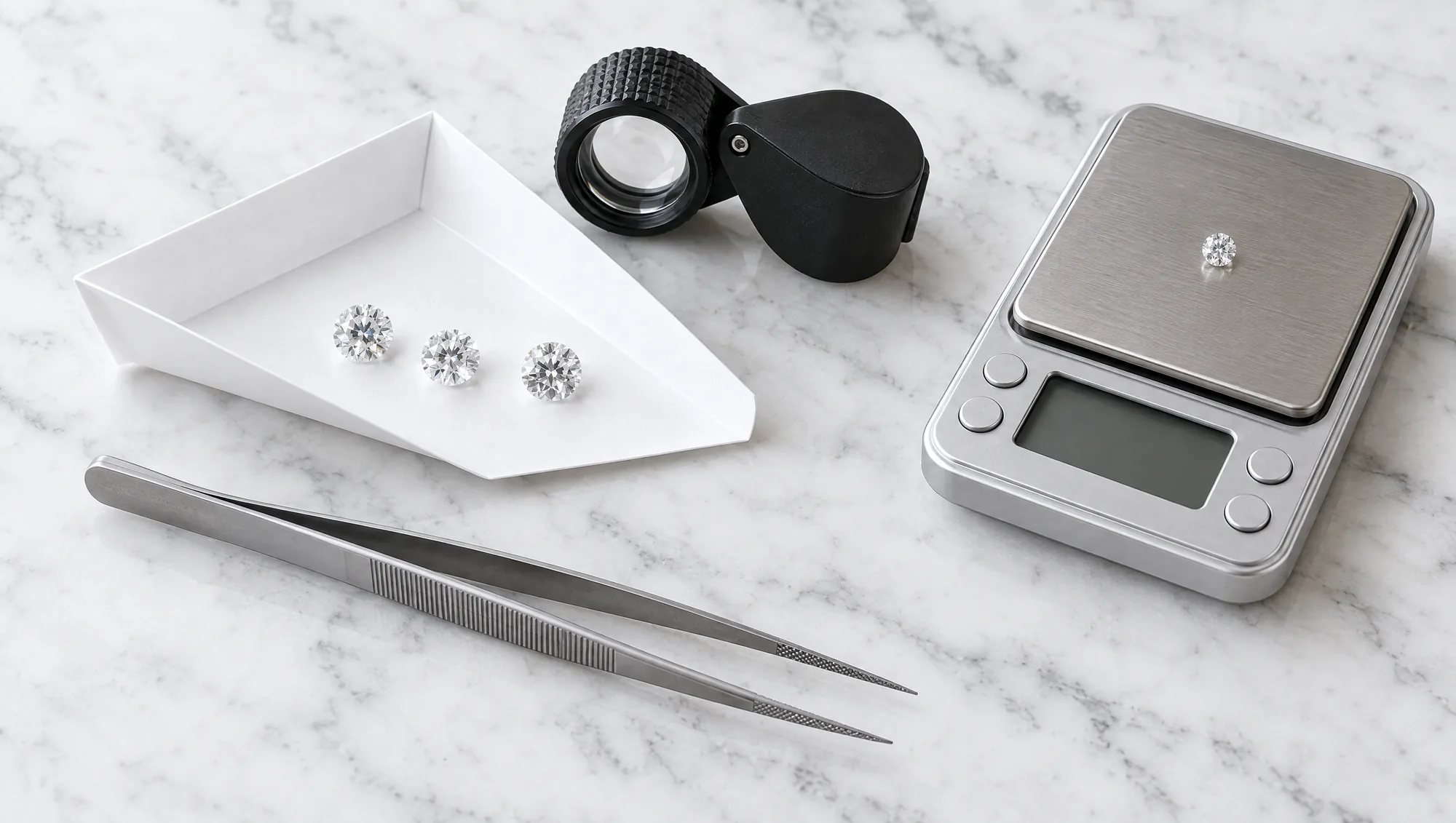
Clarity grades inclusions and surface blemishes seen at 10× magnification, on 11 steps from FL (flawless) to I3 (included).
What matters on a hand is being eye-clean: nothing visible to the naked eye, face-up, at 25 to 30 cm. That is a judgement, not a grade. Most VS2 diamonds are eye-clean, as are many SI1 rounds, whose facets hide what is inside. An emerald cut opens a window into the stone, so ask for VS1 or better. Check the report's plot too: a feather at the tip of a pear or marquise is a durability risk.
Carat: weight, not size
A carat is weight: 1 ct is 0.2 g, split into 100 points. Size grows only with the cube root of weight, so a 1.00 ct round is about 6.5 mm across and a 2.00 ct about 8.2 mm: double the weight, about a quarter wider.
Prices step up at 0.50, 1.00, 1.50 and 2.00 ct, but the eye cannot count points: a 0.95 ct round is about 6.4 mm, and 1.45 and 1.50 ct both measure about 7.4 mm. Compare a 0.95 ct round solitaire with a full carat in our designer, which moves in 0.05 ct steps; the diamond size chart covers every shape.
The four scales at a glance
| The C | Measures | Scale, best first | A sensible aim |
|---|---|---|---|
| Cut | Light return | Excellent to Poor, some labs add Ideal; GIA grades rounds only | Top grade; strong polish and symmetry |
| Colour | Absence of tint | D to F colourless, G to J near colourless, K to M faint, N to Z very light to light | G or H in white gold, H to J in yellow or rose |
| Clarity | Inclusions at 10× | FL, IF, VVS1, VVS2, VS1, VS2, SI1, SI2, I1, I2, I3 | Eye-clean: usually VS2, or a checked SI1 in a round |
| Carat | Weight: 1 ct = 0.2 g | 100 points; our designer runs 0.30 to 3.00 ct | Just under a round number |
Where to spend and where to save
- Spend on cut. A well-cut H looks livelier than a poorly cut E.
- Save on clarity. Stop at eye-clean; beyond it you pay for what only a loupe finds.
- Match colour to the metal. A grade or two higher for white gold; relax in yellow or rose.
- Check the paper. Ask for the grading report and, if the girdle carries a laser-inscribed number, check it against the report, as our guide to diamond certificates in Dubai explains.
What changes with lab-grown
Natural diamonds grow rarer, and dearer, with each step up in colour and clarity. Lab-grown diamonds are not rare, so moving from G to E, or VS2 to VVS2, usually adds far less to the price. That leaves cut and size as the choices you see. Lab-grown stones are cut to every standard, so judge the cut closely, and do not chase a D: on a hand, it is very hard to tell from an F.
Most certified lab-grown diamonds are graded by IGI, on the full D to Z and FL to I3 scales. Since October 2025, GIA's lab-grown reports give no colour or clarity grade, only one of two broad categories, Premium or Standard. When you ask us for a price, ask which colour and clarity it is for. Our comparison of lab-grown and natural diamonds covers the rest.
Questions we hear at the counter
Which of the 4Cs matters most? Cut, because it decides how the stone performs whatever its other grades. Then carat, then colour matched to the metal, then clarity up to eye-clean.
Is VVS worth paying for over VS? Not for looks: the difference is found at 10× magnification, and in most shapes the two look the same without a loupe.
Should I avoid fluorescence? Rarely. GIA finds some fluorescence, almost always blue, in about 25 to 35% of the diamonds it grades, and its research found most people cannot tell a fluorescent stone from one without in normal light. Very strong fluorescence can make a stone look hazy, but GIA puts that at fewer than 0.2% of the fluorescent diamonds it sees.
At Mazimo. Design the ring on a hand at true size in our ring designer and send it to us on WhatsApp for the price, or come and see stones and settings at Al Manal Center, Deira, a few minutes' walk from the Gold Souk. Every ring is made in 18K gold, hallmarked in Dubai, and delivered insured across the UAE at no charge.