DIAMONDS
24 October 2026
Radiant Cut vs Cushion Cut Engagement Ring: How to Choose
A radiant has straight sides and trimmed corners; a cushion has curved sides and rounded corners. We compare size, sparkle, settings and grading reports.
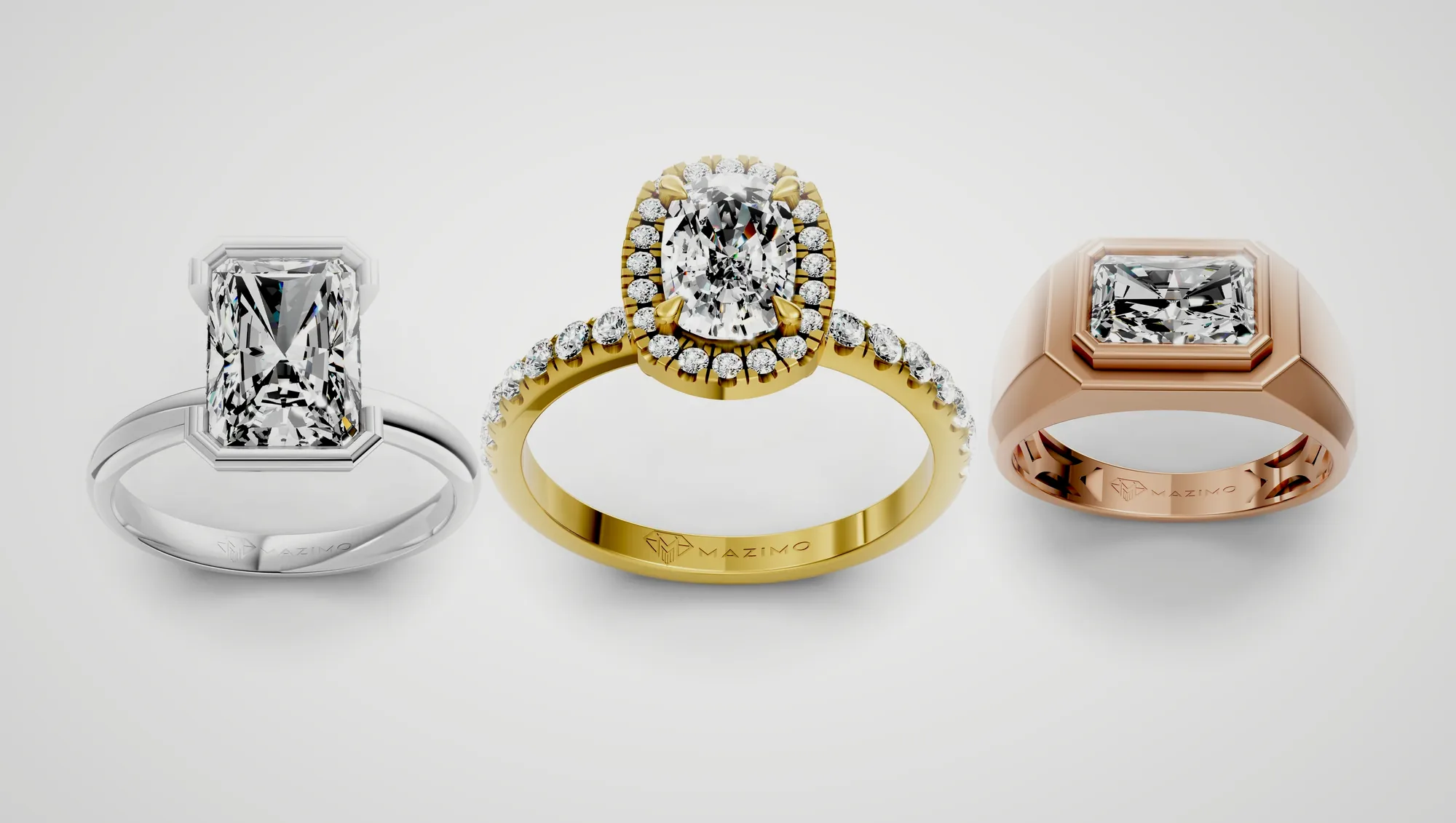
A radiant cut vs cushion cut comes down to corners. A radiant has straight sides and trimmed corners, which gives it an eight-sided outline; a cushion has curved sides and rounded corners, like a small pillow. Both come square or rectangular, and GIA gives neither an overall cut grade. Choose a radiant for crisp lines and a cushion for a softer, older look.
At a glance
- GIA describes a radiant as square or rectangular with cut corners, and a cushion as having curved sides and rounded or pointed corners.
- GIA gives a radiant 70 facets and describes cushions in two facet styles, brilliant and modified.
- GIA grades the overall cut of round brilliants only, so neither a radiant nor a cushion has an overall cut grade from GIA.
- Our two radiant and two cushion centre stones run from about 6.44 to 10.32 mm long and 4.95 to 7.10 mm wide, with length to width ratios from about 1.23 to 1.54.
- At 1 ct our designer draws a radiant at about 6.5 × 5.3 mm and a square cushion at about 6.0 × 6.0 mm, and the cushion's length times width is roughly 4 to 6% larger from 1 to 3 ct, so we call them close in size.
Sources checked 20 October 2026. IGI's site blocks automated fetches, so we read its fancy shape release and carat weight page in a browser on 24 October 2026; the list of shapes comes from a trade report we did not confirm with IGI. We did not read a grading report for a radiant or a cushion, and we did not check market prices.
Radiant cut vs cushion cut: what is different?
The outline, the corners and the age. A radiant is a rectangle or square with its corners cut off; a cushion is a rounded square or rectangle with curved sides.
| Feature | Radiant cut | Cushion cut |
|---|---|---|
| Outline | Eight-sided: straight sides and trimmed corners | Curved sides, rounded or pointed corners |
| Facets | Step-cut crown, brilliant-cut pavilion; 70 facets per GIA | Typically four or eight main facets; larger-faceted brilliant, or modified with extra facets |
| Age | Devised in 1976 or 1977 | Descends from the old mine cut of the 1700s |
| Corners | GIA says trimmed corners help prevent chipping | Girdle thicker at the corners, but can chip if extremely thin |
| Inclusions and colour | Helps mask inclusions and warm colour, per GIA | A brilliant cushion's larger facets emphasize clarity, per GIA |
| Overall GIA cut grade | None | None |
The rows rest on GIA's radiant article of 2015, shapes guide of 2025, cushion article of 2015 and 2026 guide to reading a report. Our diamond shapes guide compares all eight shapes.
What is a radiant cut diamond?
A radiant cut is a square or rectangular diamond with trimmed corners and, according to GIA, 70 facets, devised in the 1970s by the diamond cutter Henry Grossbard. It pairs the outline of an emerald cut with more sparkle.
GIA describes a crown with step-cut facets over a pavilion with brilliant-cut facets, and its 2025 guide gives a radiant 70 facets, often said to look like crushed ice. GIA's 2015 article calls the radiant a modified brilliant cut, so a report may describe it in those words. We did not read one, so ask the seller how the laboratory names the cut.
The year is disputed. JCK's obituary of Grossbard (28 April 2005) says he devised it in 1976, and GIA's 2017 article says it was created in 1977. GIA's 2015 article says the style was patented in the late 1970s, and his US patent 4,020,649, Brilliantized step cut diamond, was filed on 27 May 1976 and granted on 3 May 1977, which fits both. The patent text does not use the word radiant.
What is a cushion cut diamond?
A cushion cut is a square or rectangular diamond with rounded corners and curved sides, cut with brilliant-style facets. It is the modern form of the old mine cut, so it is far older than the radiant.
GIA's cushion article says the modern cushion brilliant typically has four or eight main facets, and that extra facets on the crown or pavilion make it a modified cushion. The 2025 shapes guide describes the two styles as brilliant cushions with larger facets and a softer sparkle, and modified cushions with extra facets.
GIA's pages disagree on how long the cushion style stayed the most common cut: until the late 19th century in a 2015 article, and until the early 20th century in a 2012 one. Our cushion cut engagement ring guide covers the square and elongated ratio bands.
Elongated cushion vs radiant: how to tell them apart
Look at the corners and the sides. A radiant's sides run straight and its corners are cut flat; an elongated cushion's sides curve and its corners are rounded. Length to width will not settle it, because both can share one ratio.
Our designer draws a 1 ct radiant at about 6.5 × 5.3 mm, a ratio of about 1.23 (6.5 ÷ 5.3), and our Cushion Octagon Halo Pavé Ring has a cushion centre of about 6.44 × 5.25 mm, also about 1.23 (6.44 ÷ 5.25). Same ratio, different corners.
GIA's radiant article says to look for a well-centred culet, parallel sides and corners cropped to identical size, and GIA's cushion article says the sides and corners should curve to a matching degree. A grade is not a picture, so check the corners by eye, ideally on a video of the actual stone.
Our radiant and cushion cut rings, in millimetres
We make two radiant and two cushion rings, all with a rectangular centre. Carat is weight, not size, as GIA says, so the table gives millimetres. Ratio is length ÷ width. Share is the stone's width (its length for the sideways Radiant Signet Ring) divided by 16.55 mm, the inside width of a UAE size 52 finger (52 ÷ 3.14159).
| Ring | Centre (L × W, mm) | Ratio | Share of a size 52 finger | Setting |
|---|---|---|---|---|
| Radiant Signet Ring | 9.05 × 6.22 | 1.45 | 55% (9.05 ÷ 16.55) | Sideways and flush in a stepped, flat-topped signet frame |
| Radiant Bezel Solitaire Ring | 10.32 × 7.10 | 1.45 | 43% (7.10 ÷ 16.55, taking the stone as lengthways) | Bezel-set on a plain band, small stones beneath the bezel |
| Cushion Halo Pavé Ring | 7.62 × 4.95 | 1.54 | 30% (4.95 ÷ 16.55) | Claw-set centre, diamond halo, pavé band |
| Cushion Octagon Halo Pavé Ring | 6.44 × 5.25 | 1.23 | 32% (5.25 ÷ 16.55) | Four-claw centre, octagon-shaped halo, pavé band |
Sizes are approximate and as of October 2026; ratios and shares are our arithmetic. All four are made to order in 18K white, yellow or rose gold, the Radiant Bezel Solitaire Ring and the two cushion rings in UAE sizes 46 to 62 and the Radiant Signet Ring in your own size. The two cushion rings have a camera try-on and the two radiant rings do not, so ask which we can show at Al Manal Center. None of the four is square; our ring designer can preview a square cushion.
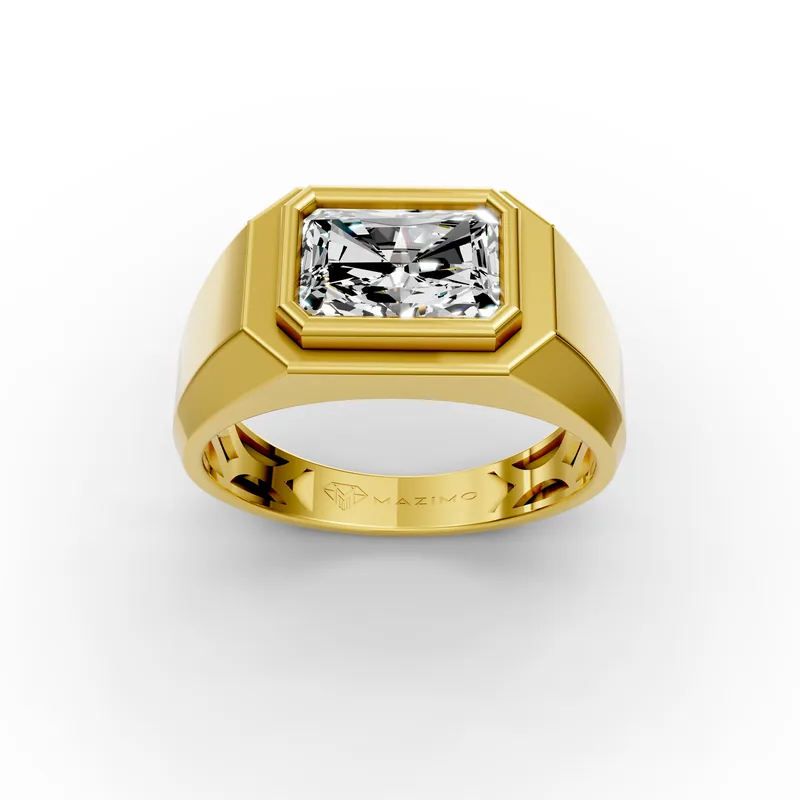 Radiant Signet RingRadiant · 2.5 ct
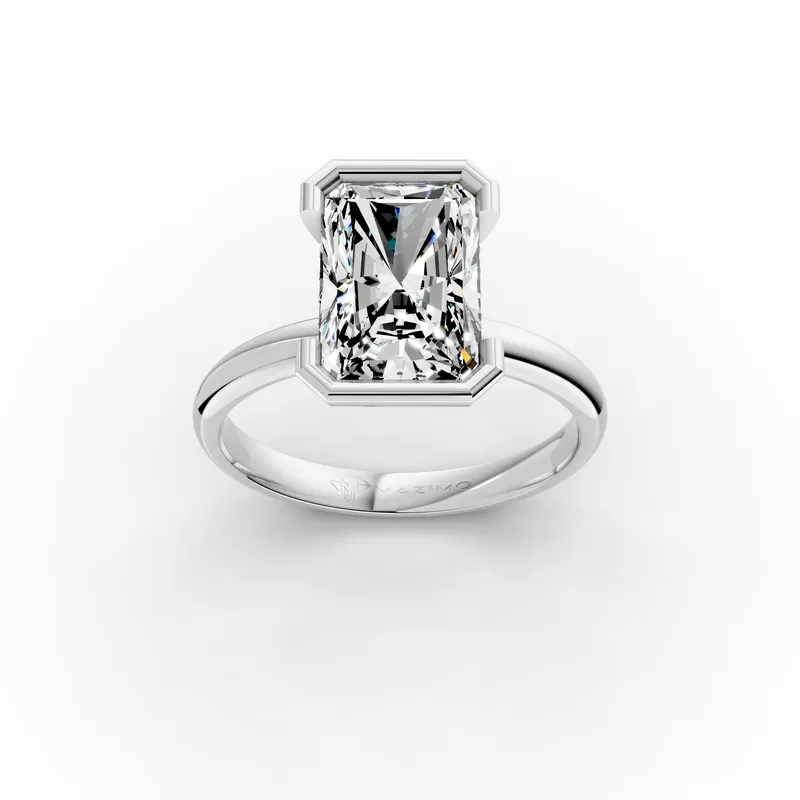 Radiant Bezel Solitaire RingRadiant · 4 ct
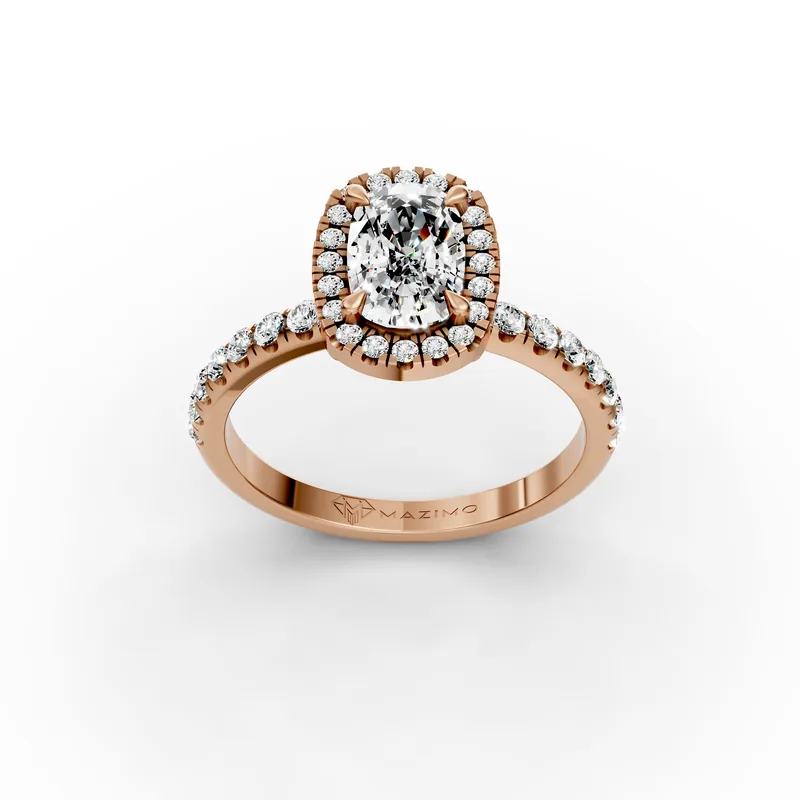 Cushion Halo Pavé RingCushion · 1.5 ct
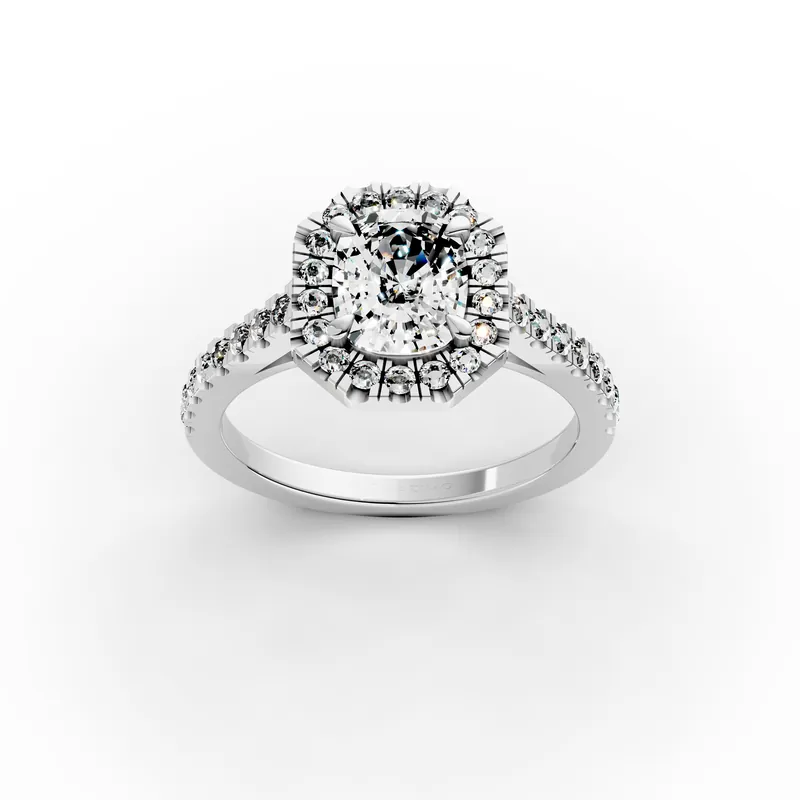 Cushion Octagon Halo Pavé RingCushion · 1.5 ct
Which looks bigger, a radiant or a cushion?
Neither clearly. At the same weight a radiant is longer and narrower and a square cushion is wider, and the length-times-width boxes in our designer differ by roughly 4 to 6%, the cushion's being larger. GIA adds that a cushion's slightly deeper proportions can make it look smaller than other shapes of the same carat weight, so compare millimetres, not carats. IGI makes the same point with numbers: its example of a cushion weighing about 1.06 carats and measuring 6.32 × 6.34 mm has a physical spread of 6.33 mm, 0.22 mm less than a round of the same weight at 6.55 mm. IGI compares a cushion with a round there and does not name the radiant.
These are the sizes in our diamond size chart. At 1 ct a radiant is about 6.5 × 5.3 mm and a square cushion about 6.0 mm each way; at 2 ct, about 8.2 × 6.7 mm against 7.6 mm; at 3 ct, about 9.4 × 7.6 mm against 8.7 mm. Length times width is about 34.5 against 36.0 mm² at 1 ct, 54.9 against 57.8 at 2 ct and 71.4 against 75.7 at 3 ct. On a size 52 finger the 1 ct radiant covers about 32% (5.3 ÷ 16.55) and the square cushion about 36% (6.0 ÷ 16.55).
A box ignores what each outline gives up at its corners, and we found no source that measures it, so we do not rank them on area. A cushion stretched to about 1.25 is 6.7 × 5.4 mm at 1 ct in our cushion guide, close to the radiant. For the shapes at one weight, see our guide to which diamond shape looks biggest.
Which sparkles more and hides inclusions better?
We found no GIA page that ranks the two, but its descriptions differ in places. GIA says a radiant's facet pattern helps mask inclusions and warm colour, while a brilliant cushion has larger facets that emphasize clarity with a softer sparkle and a modified cushion has extra facets for a crushed ice effect that GIA calls similar to a radiant's.
GIA's 2017 radiant article says the faceting conceals inclusions that an emerald cut would show more clearly. Our reading: if inclusions worry you, start with a radiant, and ask for a video of the actual stone whichever cut you choose. Our eye clean diamond guide covers clarity grades.
GIA notes that a radiant, like other modified brilliants, can make a diamond's face-up colour look lighter or darker, so judge colour face up. Our colour grade and fluorescence guide explains the letters.
Radiant vs emerald cut
Both have a rectangular outline with cut corners, but an emerald cut is a step cut with a large table and open facets that, GIA says, show inclusions and colour more easily, while GIA says a radiant can be more forgiving of inclusions. See our emerald cut engagement ring guide.
Which setting suits a radiant cut engagement ring or a cushion?
A bezel covers more of the edge, and claws let in more light. GIA says a radiant's trimmed corners help prevent chipping, and that a cushion's girdle can chip if it is extremely thin, in which case it suggests considering a bezel rather than prongs.
GIA's ring-care article says a bezel shields the girdle from knocks and advises checking prongs about every six months, or, if that seems too often, on each wedding anniversary as a yearly reminder. Its settings guide says prongs let in the most light, a bezel less, and a halo's many small stones may need more maintenance. Our bezel versus prong guide compares the two for any shape.
Our four rings cover the options. The Radiant Bezel Solitaire Ring wraps its centre in metal, with 10 small round diamonds beneath the bezel. The Radiant Signet Ring sets its stone sideways and flush, with no claws; see our signet ring guide. The two cushion rings are claw-set with halos of small rounds, which means more stones to check: see our halo engagement ring guide. Whichever you choose, ask how each corner is covered.
Both cushion rings carry small diamonds in the band (the Cushion Halo Pavé Ring page says along the shoulders, the Cushion Octagon Halo Pavé Ring page along both sides), and neither page says whether the underside is plain. GIA's settings guide says pavé-set bands can be more difficult to resize, since adjusting the ring may disturb the small stones, so settle the size first; our resizing guide explains why.
What a grading report says about each cut
A GIA Diamond Grading Report, which GIA's 2026 reading guide says covers loose natural diamonds only, names the shape and cutting style, lists length, width and depth in millimetres and grades polish and symmetry, but gives an overall cut grade only to standard round brilliants. A radiant or a cushion therefore carries no overall cut grade from GIA, and the ratio is yours to divide.
IGI is different. Its release of 1 September 2022 says it added a cut grade to its reports for loose fancy shaped diamonds, judged on light return as well as polish and symmetry, and that the grade was optional for manufacturers only during a six-month adjustment period. The release names no shapes. National Jeweler's report of 7 September 2022 listed nine, among them square cushion modified brilliant and cut-cornered square modified brilliant, and no rectangular version of either. The cut-cornered one fits GIA's description of a radiant as a modified brilliant with cut corners. We did not check whether IGI's list has changed, so read the report of the stone you are offered and ask which laboratory graded it.
Our guide to IGI and GIA reports in Dubai, the GIA and IGI report pages and our cut grade guide show where each figure sits.
Radiant or cushion: which should you choose?
Choose by outline first. Our reading, not a rule:
- Straight lines and a modern look: a radiant, whose trimmed corners keep the outline sharp.
- A softer, older look: a cushion, whose roots go back to the old mine cut.
- Inclusions that worry you: a radiant, which GIA says helps mask inclusions and warm colour. Check any cushion on a video, because a brilliant cushion's larger facets emphasize clarity.
- A slimmer line on the finger: an elongated stone of either cut; GIA says elongated radiants can make fingers look slimmer.
To compare at true size, open a 1 ct radiant solitaire in yellow gold and a 1 ct cushion solitaire in yellow gold in the designer, then browse our radiant rings and cushion rings.
Questions people ask
Is a radiant cut or a cushion cut more sparkly?
GIA gives a radiant 70 facets and a look often called crushed ice, and says a brilliant cushion has larger facets and a softer sparkle, while a modified cushion with extra facets has a similar crushed ice effect. We found no source that measures one against the other, so compare actual stones in the light you will wear them in.
Which costs more, a radiant cut or a cushion cut?
We found no primary source that ranks them. GIA says both tend to cost less per carat than round brilliants. Each ring page at our diamond rings shows its price, and our engagement ring cost guide explains what moves it.
What is the difference between an elongated cushion and a radiant cut?
The corners and sides. A radiant has straight sides and flat, trimmed corners; an elongated cushion has gently curved sides and rounded corners. Their length to width ratios can match, so look at the corners rather than the ratio.
Does a radiant cut diamond chip easily?
GIA says a radiant's trimmed corners add durability and help prevent chipping. Its separate cushion article warns that the girdle at the corners can chip if it is extremely thin, and suggests a bezel. For either cut, ask how the corners are held, and have the setting checked regularly; GIA suggests looking at prongs about every six months.
Do radiant and cushion cut diamonds get a cut grade?
Not from GIA, which gives an overall cut grade only to standard round brilliants. IGI says it added a cut grade to its reports on loose fancy shapes in 2022, but a trade report of its nine shapes named a square cushion and a square cut-cornered shape, with no rectangular version of either, so check the report of the stone you are offered.
Where can I see a radiant cut diamond ring in Dubai?
At Mazimo, Al Manal Center, Deira, minutes from the Gold Souk. We make two radiant and two cushion rings. The camera try-on is on the two cushion rings and not on the two radiant rings, so book a viewing and ask which we can show you.
At Mazimo. Preview a radiant or a cushion in our ring designer at true size on a hand, tell us whether you prefer a natural or a lab grown centre diamond, and message us on WhatsApp for the price of the ring you design. Every ring is 18K gold, hallmarked in Dubai and delivered insured across the UAE at no charge. For the rounder stone, read our cushion cut guide, and for the step cut cousin, our emerald cut guide.